Naval Operations in the Gallipoli Campaign
By the end of 1914, the war on the Western Front had reached a stalemate, with 700 kilometers of trench lines stretching from the Belgian border to Switzerland. The Allied Powers, seeking a way to break this bloody deadlock, believed that opening a new front could change the fate of the war. At this very point, Winston Churchill, the then First Lord of the British Admiralty, brought the idea of an attack against the Ottoman Empire to the table. Churchill's strategic calculation was that an attack on the Ottomans, whom he viewed as the "weak link," would force Germany to divert troops to the eastern front, thereby relieving pressure on the Western Front. Moreover, such a move could draw Balkan countries into the Allied camp and open a vital supply route to Russia through the Black Sea.
The First Step: A Purely Naval Operation
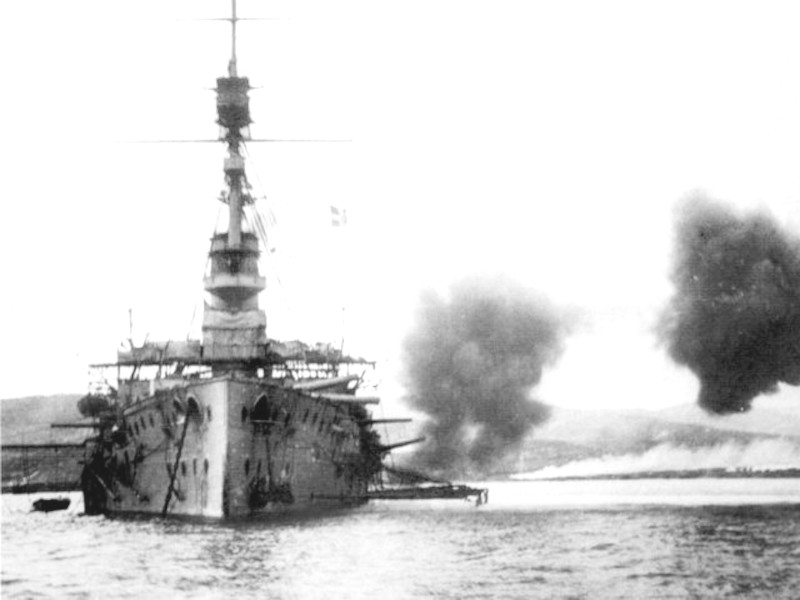
Initially, the plan relied entirely on naval power. Churchill and the British Naval Command aimed to force the Dardanelles Strait with a fleet of older battleships, silence the Ottoman coastal defenses, and then advance on Istanbul (then known as Constantinople). The appeal of this plan lay in its lack of need for a large land army and its relatively low-cost appearance. However, this optimism stemmed from underestimating the Ottoman defenses and the geographical challenges.
The First Bombardment and Initial Challenges (February 19 – March 17, 1915)
The naval campaign began on February 19, 1915, with two British destroyers bombarding the Ottoman fortresses at the mouth of the strait. Over the weeks of fighting, although some fortresses at Seddülbahir and Kumkale were damaged, these attacks yielded no decisive results. The biggest obstacle to the attacks was the mines laid by the Ottomans in the strait. British minesweepers struggled to clear these mines due to strong currents in the strait and enemy fire. This was an unforeseen complication for the planners; the belief that "Britannia ruled the waves" had begun to suffer its first wound in the waters of the Dardanelles.
March 18, 1915: The Great Disaster
The turning point of the naval campaign was the major assault on March 18, 1915. The British and French fleets under the command of Admiral John de Robeck aimed to decisively silence the Ottoman fortresses and facilitate the work of the minesweepers. However, the Ottoman forces had laid a great trap with the mine-line placed in Erenköy Bay by the minelayer Nusret.
What happened that day was a catastrophe. Three battleships—Bouvet, HMS Irresistible, and HMS Ocean—struck these mines and sank. HMS Inflexible and three other ships sustained heavy damage. Approximately 700 sailors lost their lives in this attack. This defeat painfully proved that the Dardanelles could not be passed by naval force alone.
Aftermath of the Naval Failure: The Birth of the Land Campaign
The defeat of March 18 radically changed the Allies' plans. Admiral Carden suffered a nervous breakdown following this failure and resigned, being replaced by De Robeck. The failure of the naval campaign accelerated the decision to deploy land forces. General Sir Ian Hamilton's Mediterranean Expeditionary Force was tasked with landing on the Gallipoli Peninsula to neutralize the fortresses and mines.
At this point, another critical mistake was made: despite receiving orders for the landing, Hamilton waited until April 25, 1915. This delay allowed the Ottoman defenses to strengthen further and enabled the German-commanded Ottoman army to take positions on the high ridges.
The Role of Submarines: A Glimmer of Hope and Symbolic Success
Where the great battleships had failed, submarines achieved promising success. The Australian submarine HMAS AE2 succeeded in passing through the mine-lines in the strait and entering the Sea of Marmara on April 25, 1915, just before the Anzac landings. This was the first Allied submarine to pass through the Dardanelles.
The success of the AE2 greatly boosted morale amid the deadlock on land. According to General Hamilton, the news that the AE2 had reached the Sea of Marmara eliminated the possibility of withdrawing the landing forces. In his message to the troops, Hamilton spoke his famous words: "The Australian submarine has passed the Narrows and torpedoed a gunboat at Çanakkale... You have done the difficult part, now all you have to do is dig, dig, dig until you are safe." This message, with the order to "dig, dig, dig," became a symbol of the trench warfare at Gallipoli.
The success of the AE2 was short-lived; on April 30, 1915, it was sunk by the Ottoman torpedo boat Sultanhisar, and its crew was taken prisoner. However, the presence of submarines in the Sea of Marmara continued with further successes, such as the British submarine E11 sinking the Ottoman battleship Barbaros Hayreddin in August, dealing a heavy blow to Ottoman logistics.
The naval operations in the Gallipoli Campaign were a consequence of strategic errors and overconfidence. The failure to detect mines, the lack of suitable minesweepers, the underestimation of Ottoman defenses, and logistical inadequacies were among the primary reasons for the naval campaign's failure. Today, most historians agree that after the defeat on March 18, 1915, the operation should have been completely halted and reassessed. Instead, the decision was made to launch a land invasion, which paved the way for an even greater disaster.
The failure of the naval campaign not only altered the Allied war strategy but also paved the way for commanders like Mustafa Kemal Atatürk to rise to prominence and laid the foundations for the Turkish nation's struggle for independence. In this sense, Gallipoli is not just a battle but also a symbol of a nation's resurrection.
Last Modification : 10/17/2026 2:36:53 AM