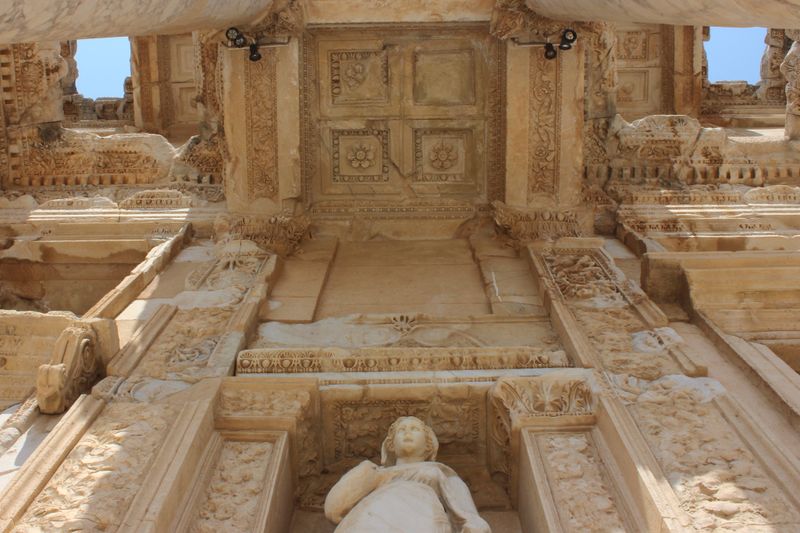
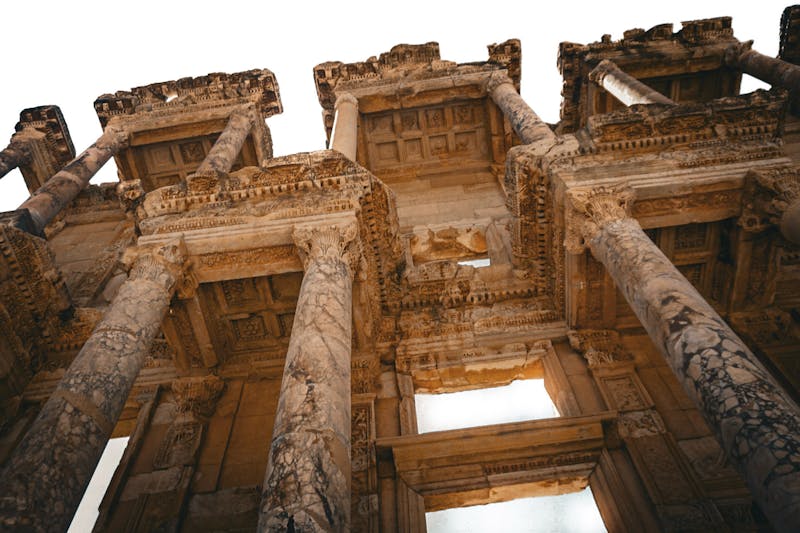
When one thinks of Ephesus, the magnificent façade of the Library of Celsus, the Great Theatre, and the Temple of Artemis—one of the Seven Wonders of the Ancient World—usually come to mind. However, behind these splendid structures lie striking details about the city's history and daily life that most visitors overlook. Here are 10 little-known facts about Ephesus.
1. 9,000 Years of Continuous Settlement
Ephesus's history is far older than most people imagine. Settlement traces dating back to 6000 BC, to the Neolithic period, have been discovered. This makes Ephesus one of the rare cities that witnessed uninterrupted settlement for approximately 9,000 years, spanning from prehistoric times through the Hellenistic, Roman, Byzantine, Beylik, and Ottoman periods. The magnificent Roman ruins we visit today represent only the final layer of this long history.
2. "Apasas" in the Hittite Period
Ephesus's earliest known name was "Apasas" during the Hittite period. Excavations have revealed Hittite-era settlements in and around Ayasuluk Hill, dating back to the Bronze Age. This name is significant in demonstrating the city's deep connections with Anatolia's ancient cultures. It is now understood that the city was an important settlement long before Greek colonization.
3. The Foundation Legend: The Fish and the Boar
Ephesus's founding is based on an intriguing legend involving a prophecy. Androklos, the son of the King of Athens, consulted the oracle at the Temple of Apollo in Delphi to learn where he should establish his new city. The oracle told him to found his city at a place "indicated by a fish and a boar." When Androklos and his men reached the mouth of the Cayster River (Küçük Menderes), they lit a fire to cook fish they had caught. At that moment, a wild boar sprang from the bushes, seized the cooking fish, and ran off. The prophecy was fulfilled, and Androklos founded Ephesus there. This legend is also depicted on the frieze of the Temple of Hadrian.
4. A City That Moved Four Times in History
The ruins we see today represent the fourth and final settlement of Ephesus. Due to geographical conditions and political reasons, Ephesus changed location four times throughout its history. While the initial settlement was around Çukuriçi Mound, it moved to the vicinity of the Temple of Artemis around 560 BC. The magnificent city we explore today was founded by Lysimachus, one of Alexander the Great's generals, around 300 BC. During the Byzantine period, it relocated to Ayasuluk Hill (modern-day Selçuk).
5. The Lost Harbour: A City That Moved Away from the Sea
Ephesus was one of the most important harbour cities of antiquity. However, the alluvium carried by the Küçük Menderes River gradually filled the harbour. Although the harbour was dredged several times during Emperor Hadrian's reign, these efforts were not permanent. Over time, Ephesus ended up approximately 5 kilometres inland, losing its strategic importance in maritime trade. While walking through Ephesus today, it is difficult to imagine that you are standing where ships once sailed.
6. Traces of Medical Activities
Although Ephesus was a city known for producing renowned physicians, no medical structures were found for a long time. However, recent research has revealed clues about medical activities in the city. On two columns in the upper city, reliefs of Hermes and Apollo—associated with medicine—are found alongside symbols such as mortars, serpents, and tripods. These symbols suggest that both divination and medical practices were carried out in this part of the city. Furthermore, an inscription found in the Church of Mary mentions a physician affiliated with the Mouseion, confirming these activities.
7. The Hidden World Beneath the Ground
Beneath Ephesus's magnificent marble streets lies an advanced infrastructure system that showcases the engineering knowledge of the era. For instance, beneath the marble slabs of Curetes Street, there is a sewerage system that kept the city clean and carried away wastewater. This system demonstrates how high the city's hygiene standards were. Similarly, the fact that the wealthy residences in the Terrace Houses had underfloor heating is yet another indicator of the quality of life in Ephesus.
8. Secret Messages Carved in Stone
Throughout the streets of Ephesus, various symbols carved into stones often go unnoticed by most visitors. The most famous of these is a "advertisement" consisting of a footprint, a woman's face, and a heart, which is believed to point to a brothel. In addition, early Christians carved secret symbols into stones to recognise one another. Alongside the "Ichthys" (fish) symbol, another symbol—a circle divided into eight parts—was used as a covert communication tool among believers.
9. The Lost Tomb of a Gladiator
In recent excavations in Ephesus, a gladiator's tomb dating back to the 3rd century was discovered. The inscription on the tomb revealed that it belonged to a gladiator named "Euphrates." Interestingly, no remains of the gladiator were found inside. The tomb was reused two centuries later as a mass grave for 12 individuals. Researchers believe that due to the tomb's careful construction and its location within a church, those buried here were likely of higher social status or were clergymen.
10. The Ancient Origin of the Crescent and Star
Although the crescent and star symbol is now known as the emblem of Turkey, its roots trace back to Ephesus. Dedicated to the city's patron goddess Artemis, this symbol frequently appears on walls and coins in the ancient city. Over time, this symbol was adopted by different cultures and evolved into its modern meaning. This symbol in Ephesus stands as a reflection of the city's ancient beliefs that has survived to the present day.
Ephesus, with its hidden stories like these behind its magnificent ruins, offers every visitor a new layer to discover. These little-known facts reveal that the ancient city is not merely a tourist attraction but a living witness to thousands of years of human history.