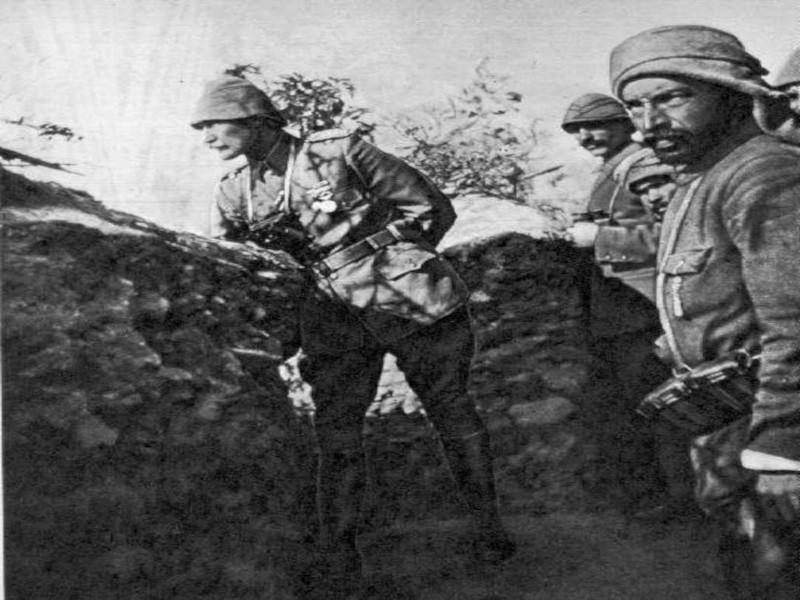
The Gallipoli Campaign represents a turning point in the Turkish nation's struggle for existence. One of the most critical phases of this struggle was the Conkbayırı Victory on August 10, 1915. This victory demonstrated to the entire world the military genius and leadership qualities of Mustafa Kemal, who at the time held the rank of Colonel, and solidified the impregnability of the Dardanelles. The Conkbayırı Battles, which took place between August 6–10, 1915, witnessed fierce clashes between Turkish forces and primarily British forces including New Zealand troops, and proved to be a critical turning point that altered the course of the war.
Strategic Context and Enemy Plans
By August 1915, the landing operations on the Gallipoli Peninsula had reached a complete stalemate. The Entente Powers, seeking to break this deadlock and capture the Straits to reach Istanbul, had prepared a new and massive offensive plan. General Ian Hamilton's Allied forces would advance on two main axes with reinforcements: a new landing would be made at Suvla Bay, while the Anzac forces at the Anzac Cove front would be reinforced to launch a major enveloping offensive known as the Sarı Bayır (Sari Bair) Operation.
At the heart of this plan lay the capture of the strategically vital Conkbayırı-Kocaçimen Tepe ridge line. Conk Tepe, the highest point at the northern end of Conkbayırı, was the key to the region. If this hill were captured, the Straits fortifications could be subjected to heavy artillery fire, and the defense of the Dardanelles would collapse. Anzac commander General Birdwood had initially advocated targeting Conkbayırı directly due to the difficulty of Kocaçimen Tepe; for if Conkbayırı were captured, the Kilitbahir Plateau could be reached and the Straits brought under control.
The Course of the Battles (August 6–10)
The Enemy's Advance
The offensive that began on the evening of August 6 developed simultaneously on both fronts. Anzac forces advanced in two columns, targeting Conkbayırı and Kocaçimen Tepe. On the morning of August 7, the right assault column under General Johnston headed toward Conkbayırı via Şahin Sırtı (Shahin Ridge). However, due to Ottoman resistance and difficult terrain, the objective could not be reached at the scheduled time.
When the 9th Division Commander Colonel Kannengiesser arrived at Conkbayırı on the morning of August 7, he found the Turkish forces in the region to be critically weak. He attempted to strengthen the defense with the two regiments at his disposal. On the morning of August 8, the British launched a fierce assault on Conkbayırı with naval support and captured the hill in the first wave. The situation was critical: Conkbayırı had fallen into enemy hands, and the path to the Straits was about to be opened.
Mustafa Kemal's Intervention
Mustafa Kemal, assessing this critical situation, after concluding the offensive at Anafartalar on August 9, arrived at Conkbayırı in the evening and decided to retake the hill. He knew that if the enemy were to establish themselves on Conkbayırı, they could threaten the Straits fortifications. After conducting reconnaissance, he determined that the most effective approach would be a surprise bayonet charge without artillery support.
The Morning of August 10: The Moment of Victory
The Bayonet Charge
On the morning of August 10, 1915, before dawn, at 4:30 AM, Mustafa Kemal personally positioned himself at the forefront of the assault line. He addressed his soldiers with the historic words:
"Soldiers! There is no doubt that we will defeat the enemy before us. But do not rush. First, I will advance. When I signal with my whip, you will all charge together!"
When Mustafa Kemal's whip rose into the air and came down, the Turkish soldiers, with their bayonets fixed, hurled themselves upon the enemy trenches like a mass of iron. The enemy, taken completely by surprise by this lightning charge executed solely with bayonets and without artillery fire, had no time to use their weapons. As a result of this heroic hand-to-hand combat, the enemy's front line was completely annihilated. This charge, carried out with cries of "Allah! Allah!" drove the enemy completely out of Conkbayırı within just four hours, and the highest point of Şahinsırt was also captured.
The Watch That Saved a Life
During the most intense moments of the battle, while Mustafa Kemal was inspecting the positions, a shrapnel fragment struck the right side of his chest. However, the shrapnel fragment shattered the watch in his breast pocket and could not penetrate his body, thus saving his life. The spot where this incident occurred is today marked with four cannonballs and a commemorative plaque.
The Consolidation of Victory
By noon, the soldiers who had been fighting continuously for eight hours were exhausted, and casualties had reached significant levels. Mustafa Kemal, recognizing that the superiority achieved against the enemy was not sustained combat power but rather a sudden and swift blow, at 12:15 PM gave the following order to the 8th Division Commander: "Halt the offensive. Strengthen your positions with your units, ensuring that Conkbayırı and the westernmost dominant point of Şahinsırt are always held." This decision was a testament to military genius and strategic composure.
The Significance and Consequences of the Conkbayırı Victory
The Conkbayırı Victory was one of the most important events that changed the course of the Gallipoli Campaign. With this victory:
- Strategic Supremacy Was Achieved: The Conkbayırı-Kocaçimen Tepe line remained firmly under Turkish control. Thus, the Entente Powers' hopes of capturing the Straits and reaching Istanbul largely came to an end.
- The Anafartalar Victory Was Solidified: The First Anafartalar Victory won on August 9–10 was crowned by the victories at Kireçtepe on August 17 and the Second Anafartalar Victory on August 21.
- Mustafa Kemal's Leadership Was Confirmed: This victory established Mustafa Kemal as the "Hero of Anafartalar" and demonstrated his military genius to the entire world. British commander General Hamilton's note summarized the situation: "The Turks realized that they could only accomplish their duty by driving us from Conkbayırı—and so they did!"
- The Foundations of the National Struggle Were Laid: This victory played a critical role in Mustafa Kemal gaining the prestige and experience necessary to launch the War of Independence in Anatolia.
The Conkbayırı Atatürk Victory Monument
Today, at Conkbayırı, the Conkbayırı Atatürk Victory Monument, commissioned by the Ministry of Culture and Tourism in 1993 and restored in 2015, stands in memory of this great victory. The bronze statue, the work of sculptor Prof. Tankut Öktem, depicts Mustafa Kemal with his whip in hand, giving the historic command for the bayonet charge. This monument is not merely a statue but a bronze embodiment of a nation's fate being reversed, of military genius and unshakable will.
The Conkbayırı Victory is a continuation and reflection of the same spirit as the Anzac Cove battles, which were etched into history with Mustafa Kemal's words: "I do not order you to attack—I order you to die!" This victory was won through the sacrifice of Turkish soldiers, the courageous and accurate decisions of the command, and Mustafa Kemal's superior leadership qualities. On that day at Conkbayırı, the charge launched with the signal of Mustafa Kemal's whip did not merely recapture a hill; it changed the fate of a nation and proved to the entire world that the Dardanelles were impregnable. Today, the commemorative ceremonies held on the anniversaries of this victory serve as an occasion to remember with respect, mercy, and gratitude this critical moment in history and all the heroes, foremost among them Mustafa Kemal Atatürk.