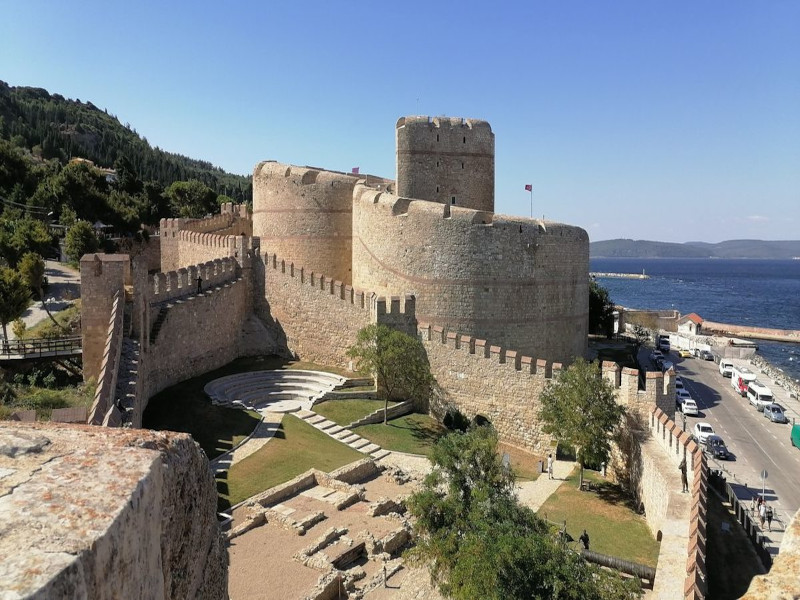
Kilitbahir Castle is a magnificent structure built by Sultan Mehmed the Conqueror after his conquest of Istanbul (Constantinople) in 1453, in order to secure control over the Dardanelles Strait. Meaning "Key of the Sea," this castle stands as a unique example of Ottoman military genius, with its distinctive architecture and centuries-long defensive function.
⚓️ Historical and Strategic Importance
Kilitbahir Castle was constructed between 1462 and 1463 by Sultan Mehmed the Conqueror following the fall of Constantinople. Built under the supervision of Yakup Pasha by the sultan's decree, the castle was positioned at the narrowest point of the Dardanelles, directly opposite Kale-i Sultaniye (Çimenlik Castle) on the Anatolian (Asian) shore. Its purpose was to completely control passage through the strait and protect Istanbul from potential attacks. The name "Kilidü'l-Bahr" (Key of the Sea) given to the castle clearly reflects this strategic role.
🏰 Unique Architectural Design
Kilitbahir Castle holds a special place in Ottoman military architecture due to its unusual ground plan. The castle, approximately 220 meters long and 120 meters wide, consists of three main sections: the outer fortress, the inner fortress, and the central main tower.
The Inner Fortress and Cloverleaf Plan: The castle's most striking feature is its inner fortress, which resembles a three-leaf clover. This design comprises three circular bastions and represents a unique example in military architecture. This layout was specifically conceived to maximize defensive capabilities.
Seven-Story Main Tower: Rising 30 meters in the center of the cloverleaf plan, the main tower has a triangular shape and contains seven floors. These levels were accessed via wooden staircases concealed within the walls. Reaching this tower for anyone attempting to capture the castle was made extremely difficult by the labyrinthine courtyards of the inner fortress.
Expansions and Restorations: During the reign of Suleiman the Magnificent (1541–1542), the castle was expanded southward with a second outer fortress and a monumental tower now known as the Sarı Kule (Yellow Tower). An inscription above the entrance gate of this addition documents its construction date. The castle also underwent restoration during the reign of Abdulhamid II (1893–1894) and was finally opened to visitors as a museum in 2018.
⚔️ Defensive Art and Function
The architecture of Kilitbahir Castle reflects the most advanced defense techniques of its time. The castle was surrounded by deep moats, and its entrances were accessed via drawbridges. Additionally, equipped with 30 cannons, the castle effectively covered the strait's width of approximately 1,250 meters within firing range, effectively blocking passage. It is known that the famous Ottoman admiral and cartographer Piri Reis once served here. The castle remained an important defensive base used by the Ottoman Empire for military purposes until recent history.
Kilitbahir Castle is more than just a military structure; it stands as a tangible symbol of Ottoman dominance over the straits and their advanced engineering understanding. With both its historical significance and architectural uniqueness, it continues to be one of the most important landmarks of Çanakkale.