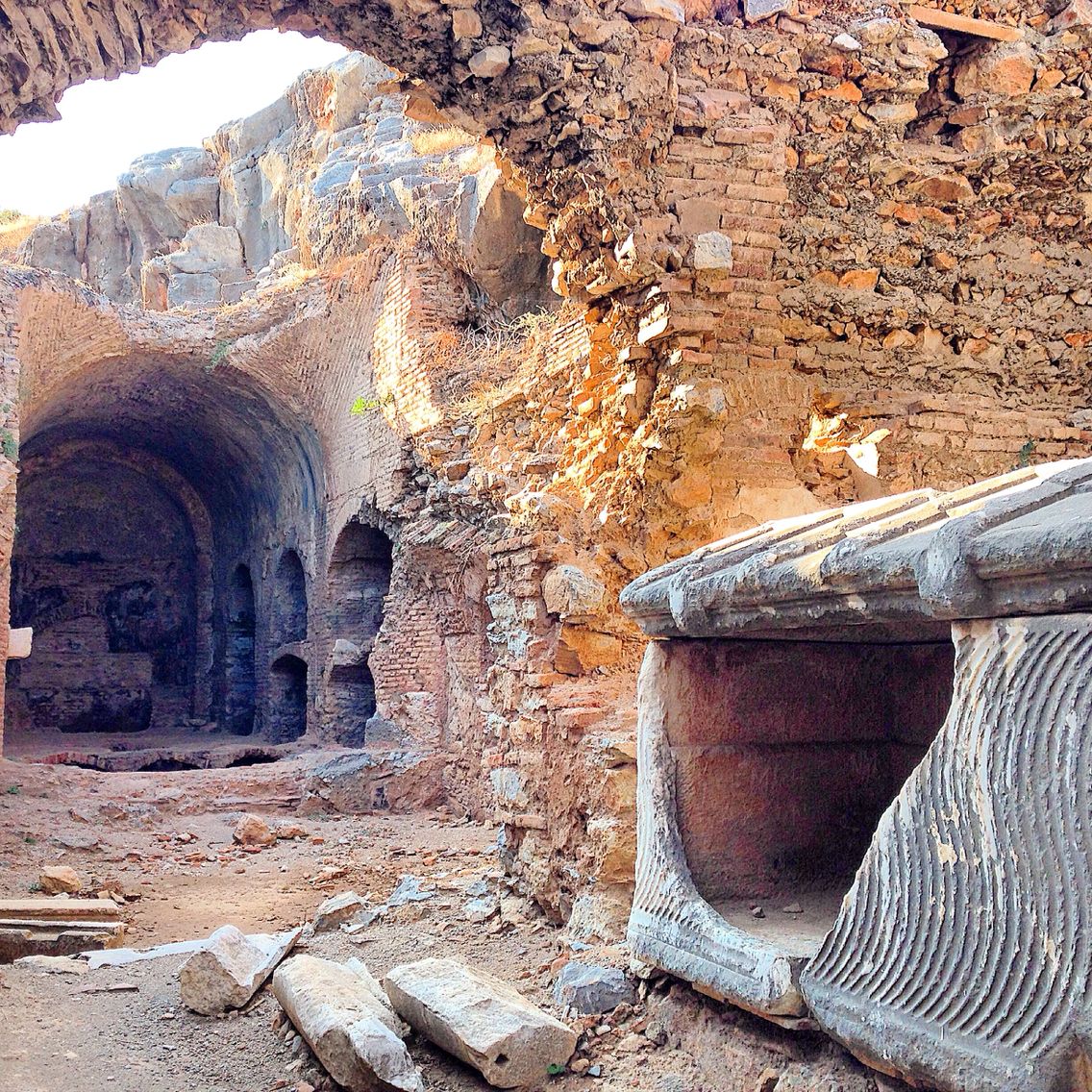
At the foothills of Mount Panayır in Selçuk, İzmir, very close to the ancient city of Ephesus, lies a cave of unique importance for both Christianity and Islam. This is the heart of the legend of the "Seven Sleepers" – or "Ashab al-Kahf" in Islamic literature – a rare place where history, miracle, and two major world religions intersect. Originating in the 3rd century, this story has evolved into a profound cultural heritage. Today, this sacred site offers visitors not only a spiritual journey but also the fresh gifts of nature and an unforgettable gastronomic experience.
The Birth of the Legend: From Persecution to Refuge
The story is rooted in the severe persecution of Christians during the reign of Roman Emperor Decius (249-251 AD). When the emperor forced everyone to sacrifice to pagan gods, seven young Christians from Ephesus defied his orders. Rather than renounce their faith, they fled the city and took refuge in a cave on Mount Panayır.
When Decius learned of their whereabouts, he ordered the cave's entrance to be sealed with stones and a wall, intending to leave the young men to die inside. But divine intervention occurred. The young men did not die; instead, they fell into a deep, divinely protected sleep.
Their identities vary across cultures. In Christian tradition, their names are Maximian, Malchus, Marcian, John, Denis, Serapion, and Constantine. In Islamic culture, they are known as Yemliha, Mekselina, Mislina, Mernuş, Debernuş, Şazenuş, Kefeştetayyuş, along with their faithful dog, Qitmir.
The Awakening: A 200-Year-Old Miracle
Nearly 200 years passed. The Roman Empire was no longer ruled by pagan emperors but by Theodosius II (408-450 AD), who had officially recognized Christianity. One day, the wall blocking the cave was accidentally opened. The seven young men opened their eyes as if waking from a single night's sleep. Feeling hungry, they sent one of their own (Yemliha) to the city to buy food.
When the young man tried to buy bread with old coins from Decius's era, the baker was shocked. Suspecting he had found treasure, the baker took him to the authorities. There, the young man learned with astonishment that he had slept for 200 years. Christianity was no longer a forbidden sect but the official religion of the empire. Understanding the situation, Yemliha returned to the cave and told his friends. Upon learning this truth, the seven young men fell asleep again, this time forever. Their miraculous awakening served as powerful evidence for the "resurrection of the body" and strengthened the faith of many.
Archaeological Reality: Proof in Stone
The legend is one of the rare stories embraced by both Christianity and Islam. It is recounted in the 18th Surah of the Qur'an, Surah Al-Kahf. This has made the cave a holy pilgrimage site for both faiths.
What truly sets this story apart is its support by concrete archaeological findings. Excavations in 1927-1928 unearthed a church built over the cave, along with numerous tombs dating to the 5th and 6th centuries. Votive inscriptions and frescoes dedicated to the "Seven Sleepers" were found on the tombstones and church walls. This evidence proves that in late antiquity, belief in these seven young men was so strong that the site became a major pilgrimage center.
A Gift of Nature: Peach Orchards
The natural beauty surrounding the Cave of the Seven Sleepers further complements its spiritual atmosphere. Looking around the cave, you will encounter lush peach trees. As a gift of the region's fertile soil, these trees are filled with fragrant, juicy peaches during the summer months.
At this point, the knowledgeable local guides step in. Thanks to their strong communication with the local people, they open the doors to an unforgettable experience. With the help of your guide, you can get in direct contact with the villagers and have the chance to pick peaches directly from the tree. Tasting a sun-ripened peach that you pick with your own hands offers nature's purest gift after a spiritual journey. Just as the Seven Sleepers defied time, in that moment, you too defy the modern rush, living a simple and peaceful moment away from the city.
The Flavor Stop: Askerin Yeri
For visitors on this spiritual journey, the region also offers an unforgettable gastronomic stop. Located very close to the cave, a place called "Askerin Yeri" (The Soldier's Place) is the go-to spot for the region's most famous traditional dish: keşkek. This Anatolian delicacy, cooked for days with lamb and pounded wheat on special stones, symbolizes patience, togetherness, and abundance, just like the story of the Seven Sleepers.
Askerin Yeri is especially famous on weekends for its traditional Turkish breakfast spread (serpme kahvaltı). These breakfast tables feature local cheeses, olives, honey, clotted cream, eggs with sausage, and more. The venue also serves gözleme – hand-rolled flatbreads filled with cheese, potato, or minced meat, cooked on a traditional griddle.
After your meal, you must try the venue's famous teapot-brewed tea (demlik çayı) , brewed for a long time and praised for its unique flavor. If you wish, you can also smoke a hookah (nargile) in this peaceful atmosphere, inhaling the thousand-year-old historical air of Ephesus while sharing the legendary silence of the Seven Sleepers.
The Cave of the Seven Sleepers is not just a pile of stones. It is a symbol of resistance against persecution and divine providence. The convergence of Christianity and Islam around the same story delivers an important message to today's world.
Visitors combine the spiritual peace from the cave with fresh peaches picked from surrounding trees with the help of their guides. They then crown their experience at Askerin Yeri with a weekend breakfast, a bowl of hot keşkek, a glass of tea, and a pleasant hookah session. This unique experience, where history, faith, nature, and flavor intertwine, sets Ephesus apart and offers visitors not just a tour, but a true life experience.