The Library of Celsus in Ephesus
One of the most magnificent structures of the ancient world, the Library of Celsus is located in the ancient city of Ephesus, near the modern-day town of Selçuk in İzmir Province, Turkey. Recognized as the third-largest library of antiquity after the libraries of Alexandria and Pergamon, this structure is not merely a treasure house of books but also a unique monument built as the tomb of a Roman governor. The impressive façade that survives to this day stands as a silent yet powerful witness to the cultural and intellectual power of the Roman Empire in the East.
History and Construction Process
The story of the Library of Celsus begins with the will of a prominent statesman of the period. The library was commissioned by Tiberius Julius Aquila in honor of his father, Tiberius Julius Celsus Polemaeanus, a Roman senator and former proconsul of the Province of Asia. Construction began in 114 AD and was completed in 117 AD. Celsus was one of the first people of Greek origin to enter the Roman Senate, serving as consul in 92 AD and as proconsul of the Province of Asia between 105 and 107 AD.
Aquila financed the construction of this magnificent structure to keep his father's memory alive and to leave a valuable cultural heritage to the people of Ephesus. It is known that Celsus bequeathed 25,000 denarii (a Roman silver coin) for the library's book collection. This was an enormous sum for the period and ensured that the library would have a rich collection.
The library possesses a unique functional versatility. While it served as a library where books were preserved and read, it was also built as a tomb monument (heroon) housing Celsus' grave. Celsus' sarcophagus was placed in a tomb located on the ground floor beneath the apsidal wall. Being buried within the city limits was a rare honor in Roman times, clearly demonstrating Celsus' high standing in Ephesus.
The Library of Celsus – The Connection of Harbor, Knowledge, and Memory
The city of Ephesus possessed one of the busiest harbors of the ancient world. The harbor was not only a gateway for commercial goods but also for ideas, scholars, manuscripts, and cultural influences. In antiquity, a harbor meant the arrival of new knowledge to a city. In this context, it is no coincidence that the Library of Celsus was located very close to the harbor of Ephesus, on the Marble Road, one of the city's main arteries. The library served as a center where papyrus scrolls, philosophical texts, scientific works, and literary pieces arriving by ship were recorded, preserved, and copied. In other words, the Library of Celsus was the intellectual counterpart of the Ephesian harbor. Just as the harbor brought goods from all over the world into the city's economy, the library recorded the knowledge that reached the city through the harbor and added it to humanity's collective memory. In this respect, the Library of Celsus is not merely a reading room or a tomb monument but also a harbor of knowledge.
Architectural Structure and Design Features
The Library of Celsus is considered one of the finest examples of Roman-period architecture. The structure is a typical example of the highly decorative façade style popular in the Eastern Roman provinces of the period.
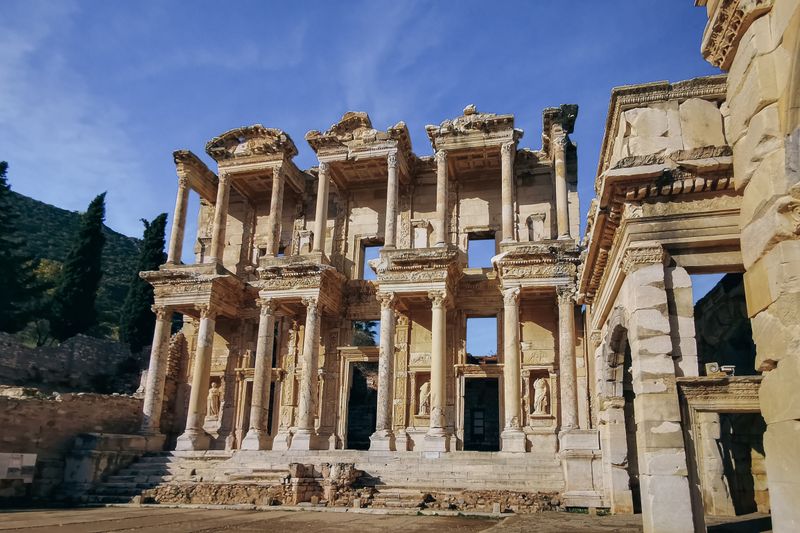
Exterior Façade: The library measures approximately 21 meters in length and 16 meters in height. It is located at the intersection of the Curetes Street and the Marble Road, two of Ephesus' main thoroughfares, at the heart of the city. The structure is accessed by a nine-step staircase, which further emphasizes its monumentality.
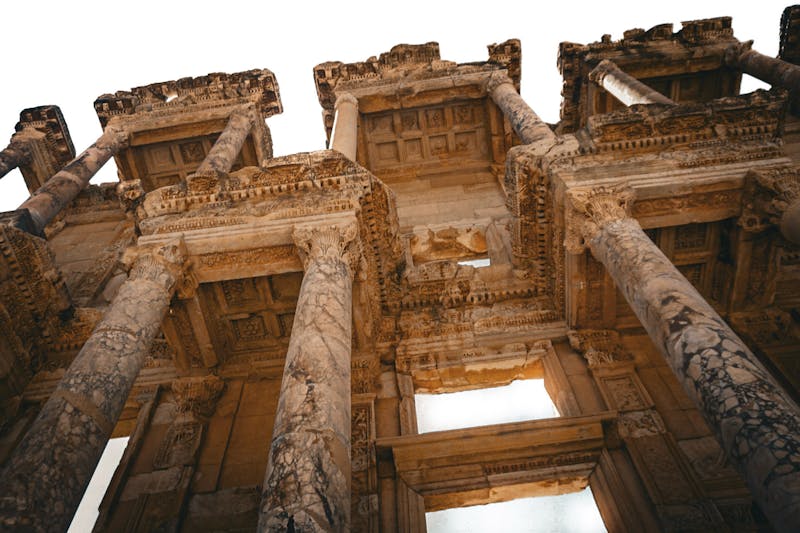
The façade is designed in two stories. On each floor, there are three pairs of Corinthian columns:
- Lower Story: Columns have capitals of a mixed Ionic-Corinthian order.
- Upper Story: Columns are of the Corinthian order. Between the column pairs on the upper story are large windows that provide light to the interior. The pediments above the windows are alternately designed in triangular and arched forms.
One of the most striking elements of the façade is the four female statues placed in niches beside the entrance doors. These statues symbolize the virtues that Celsus possessed:
- Sophia (Wisdom)
- Arete (Virtue/Excellence)
- Ennoia (Insight/Intelligence)
- Episteme (Knowledge)
The originals of these statues are now exhibited in the Ephesos Museum in Vienna, while copies are present in the niches at the library.
Interior and Preservation Techniques: The interior of the library measures 16.72 meters in length and 10.92 meters in width, covering an area of approximately 180 square meters. Although it appears to have two stories from the outside, the interior actually has three stories. The walls are equipped with 30 rectangular niches where wooden cabinets for storing parchment and papyrus scrolls were placed.
One of the most remarkable architectural features of the Library of Celsus is the innovative system developed to protect the books. A gap of approximately one meter was left between the outer and inner walls. This double-wall system helped regulate the humidity and temperature inside the library, aiming to prevent the deterioration of valuable manuscripts. This feature is clear evidence of how much Roman architects valued functional design.
Books and Collection
It is estimated that the Library of Celsus had a collection of approximately 12,000 parchment and papyrus scrolls. These scrolls were preserved in the wall niches. While the library offered reading room services to its visitors, lending books was generally not permitted. Producing copies of books was an extremely laborious and costly process in that era. Only a very privileged few might have had limited borrowing rights.
Destruction and Reconstruction
The Library of Celsus' glorious period of about a century came to an end in 262 AD. In that year, the city of Ephesus was shaken by both an earthquake and Gothic invasions. As a result of one of these disasters, the library's interior and its valuable collection were completely burned to ashes. Fortunately, the magnificent façade survived this disaster and was repaired in the late 4th century AD, with a small fountain added to it. However, a major earthquake in the 10th century caused the façade to collapse as well.
The library was unearthed through excavations conducted by Austrian archaeologists in 1903-1904. The fact that approximately 80% of the original material of the façade was recovered was a great stroke of luck for the reconstruction. Between 1970 and 1978, a comprehensive restoration project led by German archaeologist Volker Michael Strocka resulted in the façade being faithfully reconstructed. Today, visitors can stand before this magnificent façade rising in the heart of ancient Ephesus and have the opportunity to journey back nearly 1,900 years.
The Library of Celsus is a unique work reflecting the intellectual accumulation, architectural genius, and cultural magnificence of the ancient Roman world. This story, which began as a son's testament combining filial love with public benefit, is as meaningful as the library itself. Its architecture, reflecting a synthesis of Hellenistic and Roman cultures, its climate control technology, and its façade adorned with symbolic virtues elevate it from being a mere ancient structure to one of the most valuable pieces of humanity's shared cultural heritage. The surviving façade of the Library of Celsus continues to whisper to modern visitors the importance the ancient world placed on knowledge and the elegant solutions it developed to preserve it.
Last Modification : 10/17/2026 5:08:42 AM