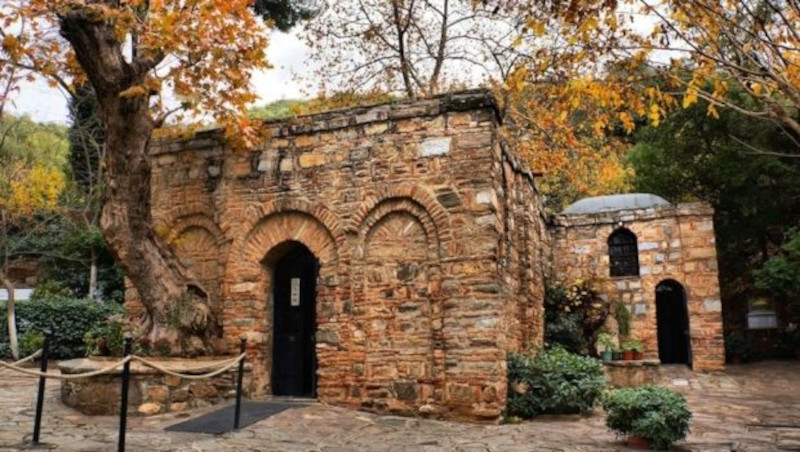
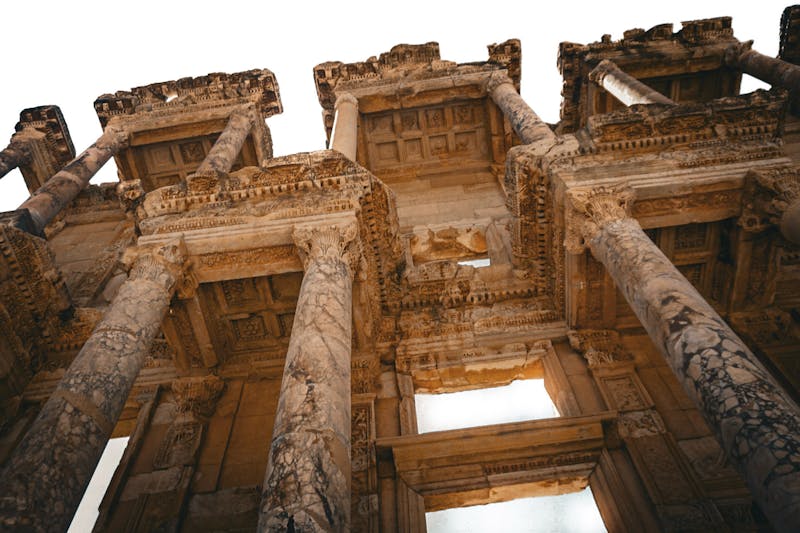
Nestled among olive trees on the slopes of Mount Bülbül, bathed in the light of the Aegean, stands a small stone house. It is neither like the magnificent Ephesus Ancient City, which proclaims Rome's grandeur with its colossal columns, nor does it carry a title in the dusty pages of history like the imposing Library of Celsus. The greatness of the House of the Virgin Mary lies not in its architecture, but in the silent grief embedded in its walls, and in the indescribable peace reflected in the eyes of millions who have set foot here over the centuries. This structure is less an archaeological find than a living memory where faith and truth, history and legend, intertwine.
In Pursuit of a Vision: The Nun's Dream
If we speak of this sacred site today, we owe it to a bedridden German nun who lived in the 19th century. Anne Catherine Emmerich, in her visions, saw lands she had never visited as if watching frames of a film; she described in detail a small, modest stone house on a mountain near Ephesus. Her visions were first dismissed as mere fantasy by the clerics of her time—until 1891, when two courageous priests, using her accounts as a map, encountered ruins on Mount Bülbül.
Even more striking was that the foreign clergymen were not the first to discover this place; the region's ancient Greek Orthodox and Muslim inhabitants had, in fact, known of it for centuries. They called it Panaya Kapulu—"The Gate to Mary." For generations, the locals had whispered that this pile of stones was no ordinary ruin, but the place where a mother drew her last breath. Thus, a nun's dream aligned with an ancient folk memory, resurrecting a sacred site that had nearly been lost to the annals of time.
Mary's Footsteps in Ephesus
Why would the Virgin Mary have come to this region after Jesus' death? The answer lies in that heartbreaking scene at the foot of the cross. According to the Gospels, as Jesus hung dying, he entrusted his mother to his beloved disciple, John. Christian tradition holds that John took this charge seriously, settling in Ephesus and bringing Mary with him. Historians suggest this likely occurred around AD 37.
What sets this stone house apart from other sacred sites, however, is a profound belief: that Mary fell asleep here (in Eastern Orthodox tradition) or was assumed into heaven here (in Catholic tradition). This is not merely a residence, but a "threshold"—its walls bearing silent witness to the moment when mortal flesh was ushered into eternity. For this reason, a visitor here does not merely view a historical relic; they step into a frozen moment in time.
The Vatican's Quiet Acknowledgment and the Pilgrimage of Popes
The Catholic Church has never dogmatically declared this house to be "definitively Mary's home," maintaining a cautious distance from scientific certainty. Yet this diplomatic silence has not diminished the site's significance; rather, it has deepened it. By granting it the status of a "Holy Place," the Church emphasized that faith-based acceptance takes precedence over archaeological proof.
From 1967 onward, this site became a favorite of the Vatican. Beginning with Pope Paul VI, followed by John Paul II, Benedict XVI, and most recently Pope Francis, popes have knelt before this modest stone house, offering prayers for peace on this land. Particularly in 1979, when John Paul II officially declared it a pilgrimage site, the House of the Virgin Mary was recognized as more than a tourist stop—it was affirmed as a spiritual center. Every year on August 15, during the solemn feast of the Assumption, the small valley transforms into a sea of white as pilgrims gather from all corners of the world.
Two Faiths on One Wall: The Shared Breath of Muslims and Christians
What makes the House of the Virgin Mary truly universal is not just its place in the Christian world, but its special reverence in the heart of Islam. Mary, the only woman mentioned by name in the Quran, is seen in Islamic tradition as the pinnacle of purity and submission. Thus, thousands of Muslim visitors come each year, drinking from the spring below the house—believed to have healing properties—making wishes, and praying in humility within these humble walls.
Architecturally, the house seems divided: in one section, Christian icons and crosses greet the visitor; in another, inscriptions of Quranic verses praising Mary. In 2006, Pope Benedict XVI perhaps best captured the spirit of the place when he said: "This house should be a house of prayer where peace is built for all of us, as heirs of Abraham." Indeed, the House of the Virgin Mary stands as one of those rare bridges where two great faiths can look upon each other with respect, surviving the centuries of crusades and religious strife that have marked history.
The Imprint of Time on the Walls
The structure seen by visitors today has not preserved all of its original stones. Built upon the ruins of a 7th-century chapel, the house was restored and reconstructed in the 1950s. However, this restoration should be seen not as an interference with history, but as a gentle retouching—a way to keep memory alive. Even now, a red painted line at the base of the wall silently speaks to visitors: "This is the original; this is the restoration; but the spirit remains the same."
Perhaps the greatest miracle of this house is that, under the shadow of the great Council of Ephesus in AD 431—which proclaimed Mary as Theotokos, the Mother of God—one can still find peace in the home of a mother. Ephesus made Mary a dogma; but this stone house on Mount Bülbül enthroned her as a mother.
The House of the Virgin Mary does not greet its visitors with the grandeur of a great cathedral, but with the intimacy of a mother's hearth. Everything about it is veiled in mystery: Did Mary truly live here? The answer to that question lies not with historians, but with the tears in the eyes of a mother and child who come here.
For this place is far more than what historians write in their books: it is a monument of loyalty—a site where the sorrow of a mother who buried her son is remembered with reverence by followers of a completely different faith in a foreign land. Perhaps humanity's most ancient longing—peace—is contained in a formula this simple: to hold a mother's home as sacred.
This stone house, however long it stands, is ultimately the symbol of something that will never crumble: the power of shared human emotion to transcend all beliefs.