Ephesus Great Theatre
: 25,000-Seat Ancient Giant Structure
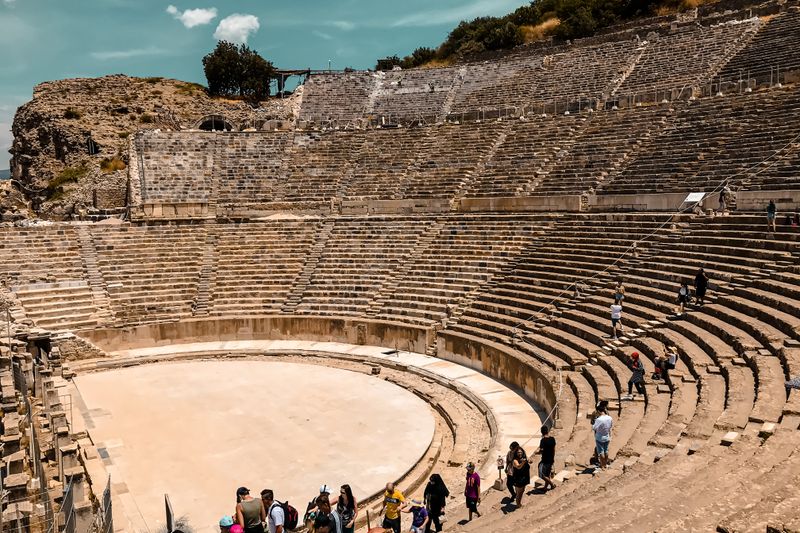
Located in the Selçuk district of İzmir, in the west of Anatolia, the Ancient City of Ephesus is a unique open-air museum that has hosted many civilizations throughout history and once held the title of capital of the Roman Empire. One of the most striking structures of this magnificent city is undoubtedly the Ephesus Great Theatre. With its enormous capacity of approximately 25,000 people, this structure is one of the largest ancient theatres not only in Anatolia but also in the entire Mediterranean world. It continues to fascinate visitors with its architectural genius, acoustics, and historical significance.
History and Construction Process
Construction of the Ephesus Great Theatre began during the Hellenistic Period in the 3rd century BC, under King Lysimachus. However, the magnificent structure seen today was expanded and completed during the Roman Empire, particularly under Emperor Claudius (41-54 AD) and then Nero (54-68 AD). At the end of a construction process lasting nearly 200 years, the theatre was integrated with a monumental stage building (scaenae frons) and seating rows (cavea) that reflected the Roman understanding of architecture.
Architectural Features
The theatre is built against the slope of Panayır Mountain (now known as Bülbül Mountain), making skillful use of the natural incline. The structure consists of three main parts:
- Cavea (Seating Rows): Arranged in 66 rows, the cavea rises in a form that exceeds a semicircle. The lower section (ima cavea) is separated from the upper section (summa cavea) by a diazoma (walkway). The seating arrangement based on social status was subject to strict rules: the front marble rows were reserved for senators and dignitaries, the middle section for the public, and the top section for women and slaves.
- Orchestra: This semicircular area in front of the stage was used for the chorus during the Hellenistic period, but was transformed into an area where important statesmen sat during the Roman period. The floor was covered with precious stones and had a substructure that could be covered.
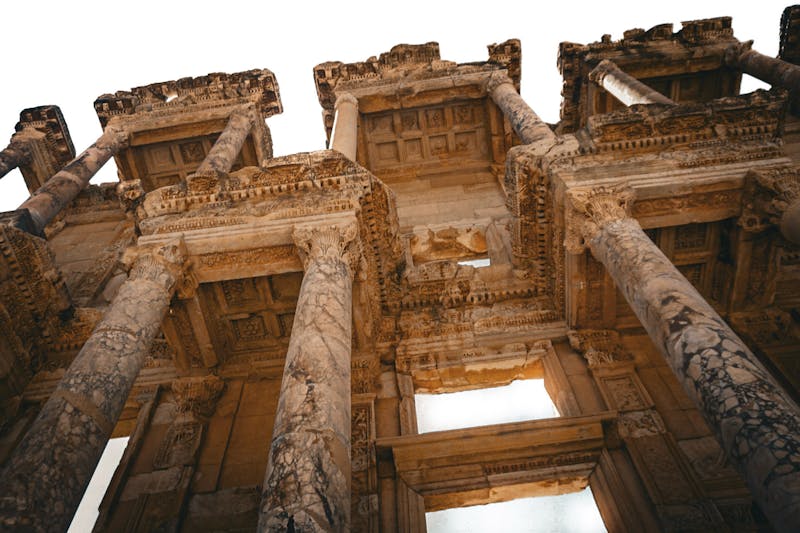
- Stage Building (Scaenae Frons): Built in three stories, the stage building had a magnificent facade adorned with marble columns, statues, and niches. Although largely ruined today, this section was originally one of the theatre's most splendid architectural elements. The proscenium in front of the stage building was a narrow, long platform where plays were performed. One of the theatre's most astonishing features is its acoustics. Even if a coin were dropped from the top row to the center of the stage, the sound can be heard. This feature was achieved solely through the calculation of the seating rows' slope, material selection, and voids, in an era when modern acoustic engineering did not exist.
Purpose and Function
The Ephesus Great Theatre served not only for theatrical plays and gladiatorial combats but also as a venue for the most important political and religious meetings of the Roman Empire. It was a center where decisions regarding the city's administration were announced to the public, criminals were tried, and important guests were welcomed.
Apostle Paul (Saint Paul) and the Ephesus Great Theatre
The Ephesus Great Theatre also holds great significance for Christian history. According to widely accepted historical and theological interpretations, it is believed that Apostle Paul (Saint Paul) was tried in this ancient theatre. While spreading Christianity in Ephesus, Paul faced great backlash from artisans associated with the cult of Artemis. As narrated in the Acts of the Apostles (Chapter 19), a crowd led by the silversmith Demetrius gathered in the theatre and started a major protest against Paul. It is believed that during this event, Paul was brought before the crowd, interrogated, and even sent to court for trial. It is known that in ancient times, public hearings and trials in major cities were generally held in theatres. Therefore, many researchers and theologians accept that Paul was tried in the orchestra section of this massive structure, before the Roman authorities and the public of the time. Although no definitive conviction was issued, this event is recorded as one of the most dramatic moments in Christian history. In this respect, it can be said that the Ephesus Great Theatre is not merely an entertainment venue but also an important witness to the early Christian period.
Modern Stars on the Ancient Stage
The Ephesus Great Theatre has become one of the most prestigious open-air stages not only of the ancient period but also of the modern era. Its unique acoustics and enchanting atmosphere have drawn world-famous artists and performance troupes to this ancient land. Among the artists who have performed on this historic stage are legendary English singer-songwriter Sir Elton John and the iconic name of Turkish pop music, Sezen Aksu. While Elton John's concert in this magnificent venue is recorded as one of the most special performances of his career, Sezen Aksu's interpretations in Ephesus witnessed the emotional meeting of modern Turkish music with thousands of years old marbles. Furthermore, the world-renowned dance show Anadolu Ateşi (Fire of Anatolia) also performed an unforgettable dance show at the Ephesus Great Theatre. This show, inspired by the dance, music, and rituals of thousands of years of Anatolian civilizations, offered the audience a veritable time travel experience in the enchanting atmosphere of the ancient theatre. The rhythmic movements of the performers on the marble stage and the magnificent choreography brought the theatre's ancient function back to life with a modern interpretation. Today, it is possible to access these unforgettable performances through digital platforms. With a quick search on YouTube (e.g., "Elton John Ephesus Theatre", "Sezen Aksu Ephesus Theatre", or "Fire of Anatolia Ephesus"), you can watch the performances of these great artists and troupes at the ancient theatre and witness firsthand how history, music, and dance meet on the same stage.
Current Status: Restoration and Visiting Conditions
Having suffered significant damage over the centuries due to earthquakes, treasure hunters, and natural decay, the Ephesus Great Theatre was being restored through excavations and restoration works that began in the early 20th century. However, as of 2026, the theatre is undergoing a comprehensive restoration process. Within the scope of these works, the structural systems of the building are being strengthened, deteriorations in the seating rows are being repaired, and the stage building is being preserved in line with its original texture. Due to the restoration, it is currently not possible to enter the theatre. Visitors can only view the magnificence of this gigantic ancient structure from a distance, panoramically, from certain points within the Ancient City of Ephesus. The hilltops opposite the theatre and the end of Harbour Street (Arcadiana Street) stand out as the most ideal spots for taking a holistic photo of the structure. Once the restoration is complete, the theatre is expected to once again host cultural events, continuing its magnificent tradition.
The Taste Left on the Palate by History and Art
The Ephesus Great Theatre is not just a structure seen with the eyes; it also offers an experience that leaves a mark on one's soul. Imagining the coolness of the ancient marble seats, hearing a musical note rising within the 2,000-year-old acoustics, or standing opposite the theatre at sunset and watching the silence—these are, in a sense, like tasting history. Just as a good meal leaves a lasting taste on the palate, this massive structure leaves a deep and lasting aesthetic flavor in one's memory. Elton John's touch on the piano keys, Sezen Aksu's interpretations echoing off the Ephesian stones, and the rhythmic steps of the Fire of Anatolia dancers on the marble stage prove that these stones offer not only a visual but also an auditory, kinetic, and emotional taste. The dramatic moments of Paul's trial have also added a completely different historical flavor to these stones. Although you cannot enter due to restoration today, a panoramic view from afar or a concert or dance show recording opened on YouTube is enough to relive this unique taste.
The Ephesus Great Theatre is not merely a structure of stone and marble; it is a magnificent synthesis of Roman architectural genius, Hellenistic aesthetics, and thousands of years of Anatolian cultural accumulation. With its enormous capacity of 25,000 people, superior acoustics, and impressive architecture, this ancient structure continues to live on in memory as one of the greatest examples of civil architecture in human history. At the same time, this sacred place, believed to be where Apostle Paul was tried, is one of the most important witnesses of Christian history. By hosting modern world legends like Elton John and Sezen Aksu, and world-famous dance troupes like Fire of Anatolia, it has built a unique bridge between the past and the present. Although you cannot enter due to restoration today, this massive structure viewed from afar, and the concert and show footage preserved on digital platforms, continue to make visitors, music lovers, and art enthusiasts feel the grandeur of the past and the flow of time and art. Standing opposite the Ephesus Great Theatre at sunset listening to the silence of history, listening to Elton John's voice echoing in that magical acoustics on YouTube, watching Sezen Aksu's emotional interpretation, watching the mesmerizing dance of Fire of Anatolia, or thinking about the moments of Paul's trial is one of the strongest connections one can establish with the past. And all these experiences remind us once again of that unique taste left on the palate by history.
Last Modification : 10/16/2026 3:16:59 AM