In the historic peninsula of Istanbul, overlooking the tranquil waters of the Golden Horn in the Fener district, stands not just an imposing architectural structure but an institution that is a symbol of nearly two thousand years of history, faith, and geopolitics: The Ecumenical Patriarchate of Constantinople. Recognized as the highest spiritual seat of the Eastern Orthodox Christian world, its religious authority and moral influence extend to hundreds of millions of Orthodox Christians worldwide, even as it leads a very small community within the borders of Turkey. This article will examine the Patriarchate's historical origins, religious significance, current status, challenges, and the physical and symbolic details of its current church.
I. Historical Origins, Rise, and Spatial Journey
The roots of the Patriarchate trace back to AD 330 when the Roman Emperor Constantine the Great moved the capital to Byzantium (renamed Constantinople). The city, referred to as the "New Rome," became a major center of Christianity. During the Byzantine Empire, the patriarchal throne was synonymous with the imperial church, Hagia Sophia.
The Fall of Constantinople in 1453 initiated a new spatial era for the Patriarchate. After Hagia Sophia was converted into a mosque, the Patriarchate was first moved to the Church of the Holy Apostles. Later, in 1456, it was relocated to the Pammakaristos Monastery, which later became known as Fethiye Mosque. The Patriarchate remained there until 1601, when it finally settled permanently in the Church of St. George in the Fener district, which continues to serve as its center to this day.
II. The Great Schism and Its Rise as the Center of Orthodoxy
The year 1054 was a turning point in Christian history. Centuries-old theological, political, and cultural disputes between the Eastern (Constantinople) and Western (Rome) churches culminated in mutual excommunications. This event, known as the Great Schism, split Christianity into its two main branches: Catholic and Orthodox. Following this division, the Ecumenical Patriarchate of Constantinople emerged as the de facto leader and the first-among-equals (primus inter pares) of the Eastern Orthodox Churches.
III. The Ottoman Period and the Millet System
After the conquest, Mehmed the Conqueror saw the Patriarchate as a tool to govern the Orthodox population. He appointed Patriarch Gennadios II Scholarios and granted him extensive autonomy as the head of the Rum Millet (Roman Millet). This system both preserved the Patriarchate and made it dependent on the Ottoman administration.
IV. The Church of St. George: Architectural and Symbolic Details of the Patriarchate's Current Home
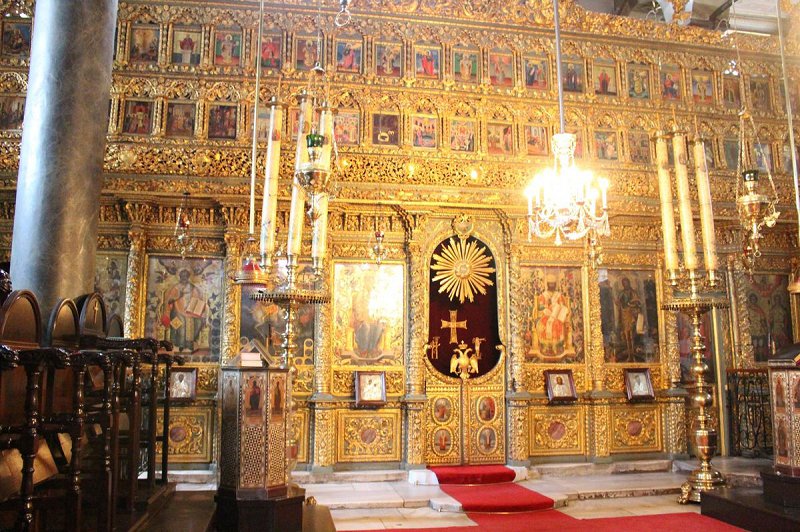
The Church of St. George, which serves as the seat of the Patriarchate today, greets visitors with a treasure trove of history and faith. The main entrance door bears a profound historical symbol: the double-headed eagle. This motif represents the Byzantine Empire's political power over both East and West, as well as the spiritual authority of the Patriarchate.
The interior of the church reflects the richness of Orthodox tradition:
- The Narthex: In the entrance hall (nartex), visitors find icons of Saint Andrew, one of Christianity's important apostles.
- The Naves: The left nave of the church features depictions of female saints. It also houses a stone revered as holy, believed in Christian tradition to be the stone upon which Jesus Christ was shackled and scourged before his crucifixion. The right nave displays icons of male saints.
- The Iconostasis: One of the most stunning features of the church is the iconostasis, the screen separating the sanctuary from the main nave. It is made of rosewood covered in gold leaf, and its intricate craftsmanship is said to have taken approximately 40 years to complete.
- The Holy Myron: In a building on the left side of the Patriarchate complex, the holy oil known as "Myron" is produced. This oil is sent to Orthodox churches throughout the world and is used in sacraments such as baptism and consecration. This is a tangible example of the Patriarchate's central role in the global Orthodox communion.
V. The Modern Turkish Republic Era and Current Status
The establishment of the Republic of Turkey in 1923 marked the end of the Patriarchate's political functions. Under the Treaty of Lausanne, it was granted the status of a purely "religious institution." Despite serious challenges, such as the closure of the Halki Theological School and the sharp decline in its local community, the Patriarchate has managed to maintain its religious significance.
VI. The Patriarchate's Current Role and Challenges
The role of the Ecumenical Patriarchate today is multidimensional: religious leadership, ecumenical dialogue, and environmental advocacy are at the forefront. However, it faces challenges such as competition with the Moscow Patriarchate, legal restrictions in Turkey, and its dwindling local congregation.
*
The Ecumenical Patriarchate of Constantinople holds a unique position, far beyond being merely a religious center. It is the heir of Byzantium, a part of the Ottoman legacy, and a distinctive institution of modern Turkey. Located in Istanbul, from the double-headed eagle on its gate to the sacred stone inside and the holy oil it distributes worldwide, every corner of this structure whispers history. Although it survives with a small local community, its spiritual weight and historical prestige make it a global actor. Its future will depend on the course of its relationship with Turkey, the balances within the Orthodox world, and its contribution to global interfaith dialogue. The Ecumenical Patriarchate remains a powerful, silent witness to both the past and the present, having endured the turbulent waves of history.