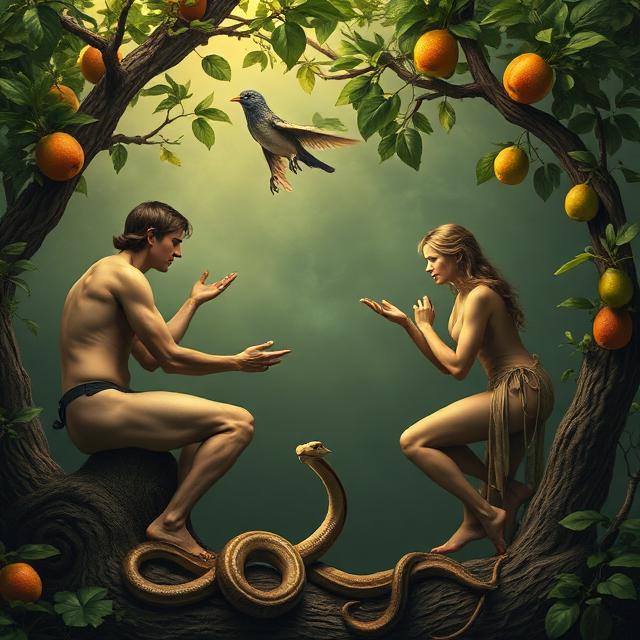
The Forbidden Fruit and Free Will
Perhaps the most striking, most debated, and most pondered scene in the creation narrative is that ancient story in the Garden of Eden. This text contains at its core the fundamental paradoxes of the human condition – knowledge and ignorance, obedience and free will, innocence and responsibility, desire and regret. Beyond being merely a religious tale, it is a universal allegory about human psychology and existence.
1. The Intersection of Cunning and Curiosity: The Art of Persuasion
The story begins with the sly question of the serpent, "the most cunning of all the wild animals." The serpent opens a door to doubt in the mind by reducing God's absolute prohibition ("you must not eat from it, nor touch it, or you will die") to a simple inquiry ("Did God really say, ‘You must not eat from any tree in the garden’?"). Eve's answer shows she remembers the prohibition, but in repeating it, she is also re-evaluating it in her own mind. The serpent's reply is a masterpiece of manipulation: it denies the threat of death ("You will certainly not die") and transforms the reason behind the prohibition into an argument of jealousy and power ("you will be like God"). Here, the allure of power and knowledge overcomes pure obedience.
2. The Heavy Burden of Knowledge: The Opening of the Eyes
One of the deepest images in the text is the phrase "the eyes of both of them were opened." The fruit of the tree of knowledge does not provide abstract knowledge, but the knowledge of distinction ("knowing good and evil"). The first consequence of this knowledge is that "they realized they were naked." Innocence gives way to a kind of self-consciousness, self-judgment, and shame. The world is no longer as it is, but as they see it. Knowledge transforms the protective paradise garden into an arena where they feel the need to hide.
3. The Distribution of Responsibility: The Birth of Human Relationships
The answers given in the face of God's interrogation reveal another aspect of human nature: the tendency to shift responsibility onto others. Adam does not directly blame God, but pushes responsibility two degrees away: "The woman you put here with me—she gave me some fruit from the tree, and I ate it." Eve then directs the responsibility to an external being: "The serpent deceived me." This dialogue shows that the dynamics of trust and blame in human relationships are as ancient as the concept of sin itself.
4. Consequences and Exile: The Acceptance of Mortality
The punishments (to the serpent, the woman, and the man) seem like the natural and inevitable consequences of their actions. Relationships become strained (man-woman, humanity-nature), life becomes difficult, pain and toil become inevitable. However, the truly dramatic outcome is the decision of exile. God's reasoning is noteworthy: "They must not be allowed to reach out, take from the tree of life, and live forever." Immortality is no longer suitable for a being who now possesses knowledge, who can discern—and therefore choose—good and evil, and who is consequently capable of choosing evil as well. By choosing knowledge with his free will, man had to leave the paradise of innocence and the possibility of immortality.
Inference: Sin or Maturation?
This story is traditionally read as the foundation of the doctrine of "Original Sin." However, it can also be interpreted as a myth about the beginning of being human. It is the story of the transition from a childlike state of obedience and protectedness to a mature existence laden with responsibility, consciousness, suffering, and the knowledge of death. "The opening of the eyes" is the starting point of human history. Being expelled from the garden is, beyond a punishment, humanity's entrance onto the world stage where it will begin to make its own history, to build culture, technology, art, and morality.
In a sense, the serpent's promise came true: By knowing good and evil, humans acquired a divine attribute. However, this attribute did not make them gods; on the contrary, it made them mortal, fragile, yet free beings responsible for their own destiny. That moment in the Garden of Eden was humanity's first step from the paradise of innocence into the history of humankind, filled with both tragedy and triumph.
Last Modification : 8/31/2026 11:04:27 AM