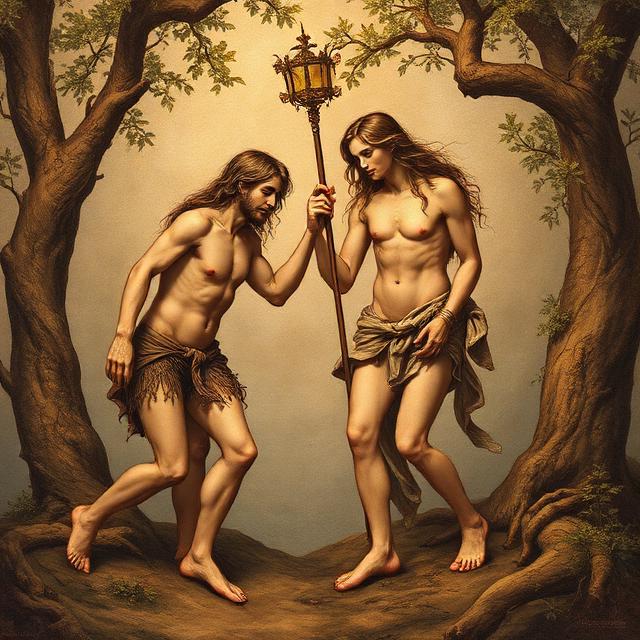
Adam and Eve
Creation myths are the cornerstones of how a culture makes sense of itself, the universe, and the meaning of existence. No story has been more influential in shaping the Western intellectual tradition in this quest for meaning than the story of Adam and Eve. This narrative is not merely a religious origin story but also a timeless philosophical treatise on human nature, free will, obedience, responsibility, and the dual nature of knowledge.
1. Perfect Order and the Divine Breath: The Two Inhabitants of Paradise
The story begins with a description of an unfinished, raw world. There was no rain, and no humans. The LORD God's creation of Adam from the "dust of the ground" (Hebrew: 'adamah') and breathing the "breath of life" into his nostrils underscores humanity's dual nature: a fusion of mortal clay and immortal spirit. Humans are part of the material world, yet possess an essence that transcends it.
Adam is placed in the Garden of Eden, a place of perfect order. This garden is a realm of peace and tranquility where nature exists in harmony with humanity, labor is without pain, and needs are met. The only rule is the divine prohibition not to eat from the "Tree of the Knowledge of Good and Evil" at its center. This prohibition is the symbolic expression of the greatest gift bestowed upon humans: free will. As long as there is an option to disobey, true obedience can exist.
2. The End of Loneliness and Becoming "One Flesh"
God's statement that "It is not good for the man to be alone" is a divine affirmation that humans are social beings. The authority to name the animals demonstrates the intellect and the role of dominion given to humans. However, Adam's inability to find a helper "suitable for him" points to an ontological loneliness.
The solution comes from a "rib" taken from Adam. This metaphorical narrative emphasizes the shared nature of woman and man, their complementarity, and their profound connection. Adam's words, "This is now bone of my bones and flesh of my flesh," express this unity. The idea of becoming "one flesh" is not merely a physical union but a spiritual, emotional, and existential integration. This is the foundation of the deepest sense of belonging in human relationships.
3. Forbidden Knowledge and the Heavy Burden of Choice
The most dramatic part of the story is the transgression of the prohibition. The Tree of the Knowledge of Good and Evil represents not only moral knowledge but all knowledge, experience, and the responsibility that comes with it. The state of innocence in Paradise is a state of childhood where there is no necessity to make choices, and therefore, no moral responsibility.
Transgressing the prohibition is the symbolic moment of humanity's transition from a state of childhood to adulthood, from pure consciousness to a being with moral agency. This transition inevitably brings with it a "fall." To know everything, to be able to distinguish good from evil, also means bearing the burden of fallibility, guilt, and facing consequences.
4. Consequences: Shame, Toil, and Facing Mortality
Immediately after the transgression, Adam and Eve's eyes are opened, and they feel shame upon realizing they are naked. This is the first manifestation of self-consciousness. Humans can now look at themselves from the outside, judge themselves, and feel the need to hide.
Expulsion from Paradise is the inevitable outcome. Life is no longer effortless and painless as it was in the garden. Humans will now earn their bread "by the sweat of [their] brow," childbirth will become a painful process, and ultimately, because they are "from dust," they will return to dust—to death. This is the price of the loss of innocence.
Epilogue: A Curse or an Liberation?
Traditionally interpreted through the doctrine of "Original Sin," this story is often seen as a fall and a curse. However, from another perspective, this is also the beginning of being truly human. Without knowledge, free will, and the capacity for moral choice, humans could not be fully "human." Existence in the Garden of Eden was a comfortable but passive childhood; the expulsion is a difficult, painful, but autonomous and responsible state of adulthood.
The story of Adam and Eve reminds us of the tragic and yet glorious paradox of the human condition: Wisdom is inevitably gained at the cost of lost innocence. It is a universal journey, a microcosm of which each of us lives in our own lives as we eat from the fruit of knowledge and face the responsibilities it brings.
Last Modification : 8/31/2026 11:04:24 AM