Tekfur Palace
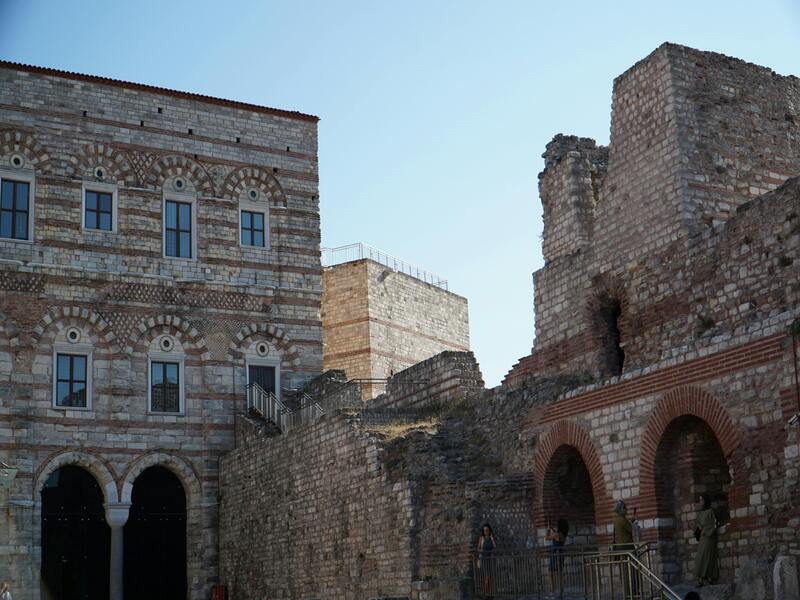
For those planning to explore the ancient walls of Istanbul, Tekfur Palace is undoubtedly a must-see destination. Long neglected and left to decay, this structure has been revived through meticulous restoration efforts led by the Istanbul Metropolitan Municipality and is now open to visitors. Today, it offers a unique experience both architecturally and historically, standing as one of the few surviving remnants of the late Byzantine era.
During the Roman Empire, the shores of the Golden Horn were favored retreats for emperors seeking respite during the summer months. The Blachernae district, in particular, became a prime location for imperial summer residences due to its natural setting and cool breezes. The Blachernae Palace built in this area suffered significant damage during the Fourth Crusade in 1204. With the Latin occupation of Constantinople lasting nearly fifty years, the main imperial palace in Sultanahmet was looted and rendered unusable. After the Latin rule ended, the returning Byzantines chose to reside in the Blachernae Palace, which was both more livable and strategically located. Today, only a portion of this palace remains and can be visited as a museum.
Tekfur Palace’s location, adjacent to the city walls, provided strategic advantages: it allowed for quick escape in case of internal uprisings and offered visibility against external threats. Its proximity to the fortifications made it an ideal structure for both defense and retreat. In Ottoman Turkish, the word “tekfur” referred to a governor. During the waning days of the Byzantine Empire, the Ottomans named this building “Tekfur Palace,” implying that the Roman emperor could now only be considered a provincial governor under Ottoman authority. In academic circles, the palace is known as the Palace of Porphyrogenitus.
Following the conquest of Constantinople, the Ottomans repurposed Tekfur Palace as a workshop for ceramic production, highlighting its continued relevance in the realm of art and craftsmanship. By the mid-19th century, the area surrounding the palace came to be known as “Yahudihane,” becoming a neighborhood inhabited by a vibrant Jewish community. However, one of the many devastating fires that plagued Istanbul throughout its history struck this area as well. The great fire of 1865 severely damaged both the neighborhood and the palace itself.
Today, Tekfur Palace welcomes visitors as a testament to Istanbul’s layered history. In its stones, one can trace the grandeur of Byzantium, the pragmatism of the Ottomans, and the ever-changing face of the city. Its silent walls still have much to tell to those who seek to uncover the stories of the past.
Last Modification : 10/17/2026 4:38:15 AM