Trafalgar Square in London, Place de la Concorde in Paris, Times Square in New York, Dam Square in Amsterdam... Every major city has a square that is integrated with its identity, has witnessed its history, and stands at the center of its social life. The most important and symbolic square of Istanbul, which rivals these global cities, is undoubtedly Taksim Square.
History: Transformation from Cemeteries to Barracks, from Barracks to a Modern Square
To understand Taksim Square's current dynamic identity, one must look at its past. During the Ottoman period, this area outside the city walls was largely covered with cemeteries belonging to non-Muslim communities. In the 19th century, the area's character began to change. A magnificent Artillery Barracks was built here as part of the modernization efforts of the Ottoman army. However, during the reign of Sultan Abdul Hamid II, the barracks were closed on the grounds that the military coup attempt, known as the 31 March Incident (1909), was orchestrated from these barracks.
The courtyard of the closed barracks was converted into one of Istanbul's first football pitches, the Taksim Stadium. This pitch hosted football matches and boxing fights in the early republican period, witnessing the birth of modern sports life in Istanbul. The Talimhane district, known today as the hotels area, takes its name from the drill field of this very artillery barracks.
The Symbol of the Square: The Republic Monument
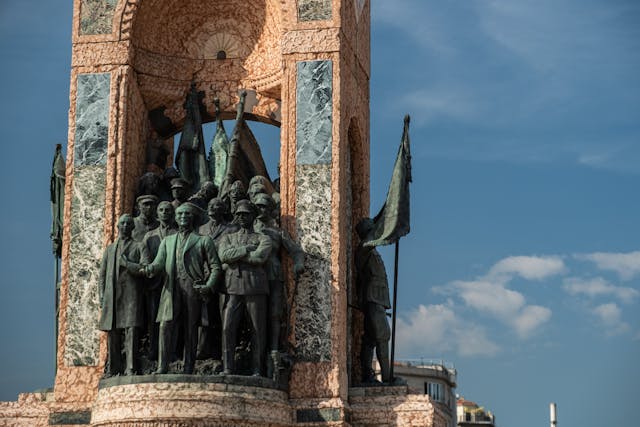
The most important symbol of Taksim Square is undoubtedly the Republic Monument, erected in 1928. Designed by the Italian sculptor Pietro Canonica, the monument symbolizes the founding ideology and modernization vision of the Republic of Turkey. One side of the monument features Mustafa Kemal Atatürk, representing Republican Turkey, while the other side depicts soldier figures symbolizing the War of Independence. This 11-meter-high monument is not merely an ornament for the square but also a concrete expression of Turkey's national identity and secular republican values. The monument cemented the square's political and symbolic importance, transforming Taksim into a space representing Republican values.
Meeting Point of Culture and Green: AKM and Gezi Park
Two major attractions of Taksim Square are the Atatürk Cultural Center (AKM) and Gezi Park.
The Atatürk Cultural Center (AKM), opened in 1969 and renovated and reopened in 2021, is an iconic arts and culture center. Hosting events such as opera, ballet, theater, and concerts, the AKM is one of Turkey's most important cultural institutions. With its architectural design and cultural mission, it represents the modern face of Taksim.
Gezi Park, located right next to the square, functions as an oasis for breathing amidst the concrete jungle. Created in the 1940s after the demolition of the Artillery Barracks, the park gets its name from the Gezi Park protests in 2013, which became a significant turning point in Turkish history. Today, the park continues to exist both as a quiet recreational area and as a living part of collective memory.
A Social and Cultural Crossroads
Taksim Square is the starting point of Istanbul's most vibrant social and cultural artery. Istiklal Avenue, stretching from the square to Tünel, with its historic passages, cinemas, theaters, bookstores, cafes, and shops, resembles an open-air museum. The nostalgic tram is a symbol that takes one on a journey through time along this lively corridor.
The Stage of Political History and Collective Memory
Taksim Square has witnessed events that left deep marks on Turkey's recent political history. The events of May 1, 1977, known as "Bloody May Day," are one of the darkest pages in the square's memory. The Gezi Park protests in 2013 once again brought Taksim to the world's attention, making the square the most visible venue for civil disobedience and social dissent.
Taksim Today: Ongoing Transformation
In recent years, Taksim Square and its surroundings have undergone a major transformation. The complete pedestrianization of Istiklal Avenue and the closure of Taksim Square to vehicular traffic for redevelopment are products of efforts to make this key point of the city more pedestrian-friendly. The opening of Taksim Mosque in 2020 significantly altered the square's silhouette and sparked new debates about its identity.
Taksim Square is one of the places that best reflects the soul of Istanbul. With its multi-layered identity—stretching from the Republic Monument to the AKM, from Gezi Park to Istiklal Avenue—it is not just a transportation hub but also a crossroads of history, culture, and collective memory. This land, which once hosted quiet cemeteries and noisy artillery drills, has transformed over time into the city's most vibrant center. Meaning different things to every visitor, Taksim, carrying the burden of its past and with its dynamic, ever-changing identity, continues to be the unquestionable heart of Istanbul. Its noise, chaos, and energy are a reflection of this ancient city's joy of life, contradictions, and perpetually transforming spirit.