On the Shores of the Golden Horn
Istanbul’s global allure today is shaped not only by its modern metropolitan identity but also by its millennia-old historical legacy. At the heart of this transformation lies the Golden Horn—a geographical gift that has served as a strategic axis, a cultural stage, and an architectural memoryscape throughout the ages.
An Emperor’s Vision: Constantine and the New Rome
In his search for a new capital in the eastern reaches of the Roman Empire, Emperor Constantine observed the uninterrupted maritime trade along the Bosphorus and the sheltered nature of the Golden Horn. His decision was clear: the New Rome would be founded here. The small settlement once known as Byzantium was thus elevated to imperial prominence. Initially named Nova Roma, the city soon came to be known as Constantinople, a name that not only honored its founder but also marked the emergence of a new imperial heart for Eastern Rome.
A Cultural Mosaic Along the Golden Horn
The shores of the Golden Horn have long been home to a rich mosaic of ethnic and religious communities. Armenians, Greeks, Jews, and Turks established their own neighborhoods along these waters, imprinting their beliefs, traditions, and architectural styles onto the landscape. This diversity is evident not only in the social fabric but also in the vibrant colors of the buildings, the textures of the streets, and the multiplicity of sacred spaces.
The neighborhoods of Fener and Balat exemplify this mosaic. With their colorful houses, cobbled streets, and winding staircases, they resemble open-air museums along the Golden Horn. The most prominent structure in Fener is the Ecumenical Patriarchate of Constantinople. After the conquest of Istanbul, and the conversion of Hagia Sophia into a mosque, the patriarchate relocated several times before settling in its current location. Today, it continues to send holy oil to Orthodox churches around the world, symbolizing both spiritual continuity and spatial resilience.
Architectural Memory: Churches, Schools, and Iron-Clad Sanctuaries
The Fener Greek Orthodox College dominates the skyline of the neighborhood. Its grand architecture has led many locals to mistake it for the patriarchate itself. Adjacent to it stands the Church of St. Mary of the Mongols, colloquially known as the “Bloody Church.” Protected by a decree from Sultan Mehmed II, it remains the only church in Istanbul to have continuously functioned since the Roman era without being converted into a mosque.
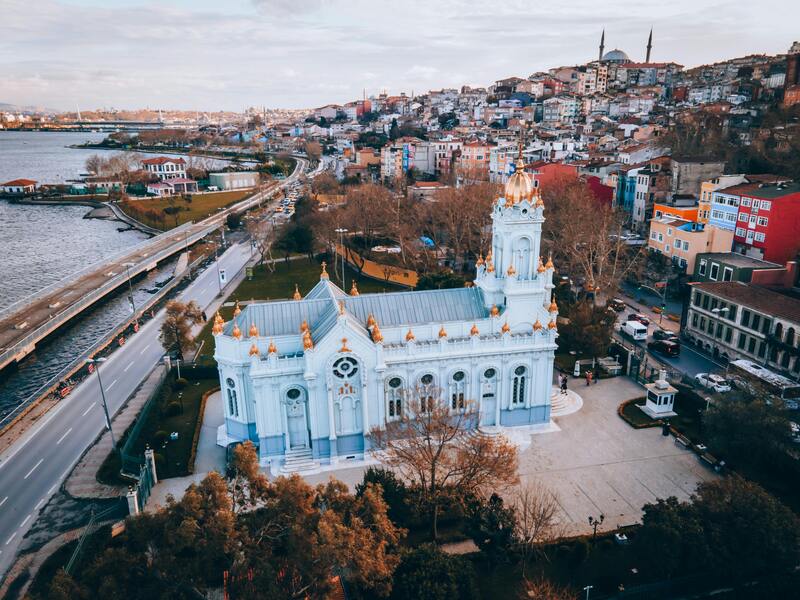
Another striking structure is the Iron Church, also known as the Bulgarian Church. Its exterior is entirely made of iron, while its interior gleams with golden ornamentation—an architectural marvel both in material and symbolism.
Cibali: A Neighborhood Named After a Soldier
Neighboring Fener is the district of Cibali, named after Cebe Ali, the soldier who breached the city walls during the conquest of Istanbul. One of its most intriguing landmarks is the Rose Mosque, originally a Byzantine church. Another emblematic site is the old tobacco factory, now home to a private university. Popularized by a Turkish song, the building is well-known among locals. Though the university is closed to visitors, its historic Byzantine cistern remains open to the public, offering a glimpse into the city’s layered past.
Istanbul in the Memory of the Golden Horn
The Golden Horn is more than a geographical formation—it is the vessel of Istanbul’s historical memory, cultural diversity, and architectural heritage. The neighborhoods, buildings, and stories shaped along its shores carry the city’s past into the present. What began with Constantine’s strategic vision continues today in the echoes of prayers, church bells, and street tales that ripple along the waters of the Golden Horn.
Last Modification : 10/17/2026 4:39:51 AM