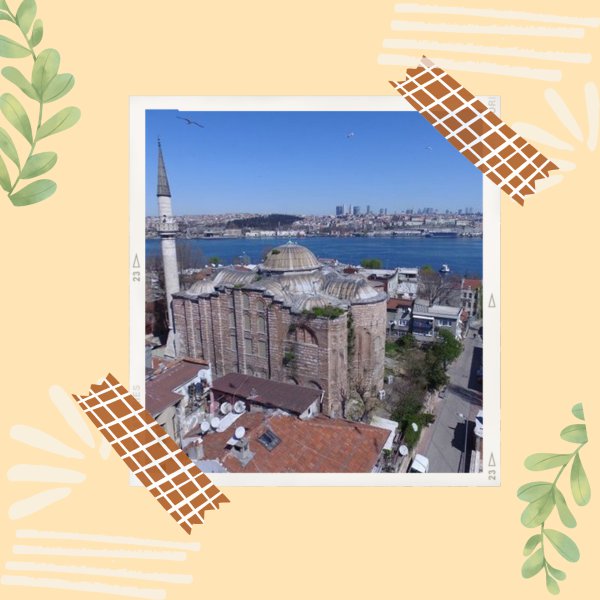
Gul Mosque
Among the hundreds of historical monuments that adorn Istanbul's skyline, each one bears witness to a different story. One of these is the Gul Mosque, standing silently yet majestically on the shore of the Golden Horn in the Fener district. Contrary to the delicacy evoked by the word "gül" (rose) in its name, its imposing structure and deep history harbor a multi-layered past stretching from Byzantium to the Ottoman Empire. In this article, we will examine the Gul Mosque's journey of over a thousand years, its architectural features, and its place in the city's memory.
The origins of the Gul Mosque date back to the most brilliant periods of the Byzantine Empire, the 11th and 12th centuries. The structure was originally built as a church dedicated to Saint Euphemia of Chalcedon. Furthermore, the fact that Saint Theodosia, known for her resistance to the iconoclasm movement, was buried in the garden of this church, added distinct religious significance to the site. Evidence that pilgrims heading to Jerusalem during the Roman era would lodge around this church in Constantinople indicates it also functioned as a stop on a pilgrimage route.
After the conquest of Istanbul, the structure remained idle for a long time, and during the Ottoman period, records indicate it was used for some time as a naval arsenal depot or a dungeon. The building was converted into a mosque towards the end of the 15th or beginning of the 16th century, but its most significant transformation occurred in the 17th century. Under the patronage of either Hatice Sultan, the daughter of Mehmed IV, or Kösem Sultan, the wife of Ahmed I, the building, which had been damaged in the 1499 earthquake, underwent a major repair and finally attained official mosque status at the end of the 17th century.
There are several interesting stories regarding how the mosque acquired the name "Gül" (Rose). According to one of the most common tales, when the Turks conquered Istanbul, they found the building adorned with roses because it was the feast day of Saint Theodosia, and thus named the structure "Gül." Another story suggests that a dervish named Gül Baba, who was martyred in this area during the conquest, was buried here, and the mosque was named after him. It is also claimed that during repairs carried out in the era of Murad IV, the dome and its surroundings were thought to resemble a rose, leading to the name "Gül Mosque."
Architecturally, the Gul Mosque bears all the characteristics of a typical Byzantine structure. Its main plan is that of a cross-shaped basilica, featuring a large central dome supported by three apses. The typical Byzantine masonry technique of alternating layers of brick and stone is clearly visible in its construction. The additions made during the Ottoman period combine functionality with aesthetics. An elegant cut-stone minaret was added to the northwest corner of the mosque, a wooden-roofed portico for latecomers was built in front of the structure, and Islamic elements such as a mihrab and minbar were placed inside.
Today, the Gul Mosque is actively open for worship. This monumental structure, maintained through various restorations over time, is more than just a religious site; it is a silent symbol of how different cultures can coexist in Istanbul. For those wandering the back streets of the Golden Horn, for those wishing to witness history, it is a treasure waiting to be discovered.
In conclusion, the Gul Mosque is not merely a pile of stones but rather a living history book. Within its walls, it holds the echoes of Byzantine imperial ceremonies, the silence of the post-conquest period, and the sounds of Ottoman prayers. The poetry of its name and the splendor of its architecture make it one of the most valuable pieces of Istanbul's multicultural mosaic. The Gul Mosque offers visitors a chance to listen to the ancient story of the city, if only we are willing to lend an ear.
Last Modification : 9/1/2026 1:53:06 PM