Eyup Sultan
When one thinks of Istanbul, the first things that come to mind are the call to prayer rising from minarets, the magnificent Golden Horn, and majestic historical monuments. However, to understand the soul of this ancient city, one must journey to its spiritual heart, the capital of serenity and peace: Eyüp Sultan. This is not merely a district; it is a major spiritual center for Muslims where faith, history, and culture have been interwoven for centuries.
A Companion from the Pages of History The story of Eyüp Sultan dates back to centuries before the conquest of Istanbul, to the early years of Islam. Abu Ayyub al-Ansari (may Allah be pleased with him), whose real name was Khalid bin Zayd, was an important Companion who hosted the Prophet Muhammad (peace be upon him) in his home after the migration to Medina, remained by his side throughout his life, and participated in many battles. In his old age, he joined the Islamic armies in the first siege of Constantinople (668-670 CE), where he fell ill and passed away. According to his wish, he was buried at the farthest point of the military encampment. Over time, the location of his grave was forgotten, until the conquest of Istanbul...
Conquest and Discovery: The Finding of a Lost Grave After conquering Istanbul on May 29, 1453, Sultan Mehmed the Conqueror always placed great importance on the spiritual dimension of the conquest. His teacher, Akşemseddin, saw the location of Abu Ayyub al-Ansari's grave in a dream one night. Upon the Sultan's order, excavations were carried out, leading to the discovery of a marble sarcophagus and a stone inscribed with "Haza kabri Ebu Eyyub" (This is the tomb of Abu Ayyub) at the site of the present-day tomb. This discovery became a great source of spiritual motivation for the Ottomans.
The Birth of a Complex and the Shaping of a District Sultan Mehmed the Conqueror built a large complex (külliye) around this sacred site. This collection of structures, comprising a mosque, tomb, madrasa, bathhouse, soup kitchen (imaret), and fountains, laid the foundation of the Eyüp Sultan district. Over time, this area evolved into a prestigious settlement, becoming the site where Ottoman Sultans performed their sword-girding (accession) ceremonies and where thousands of statesmen and common folk wished to be buried. As Eyüp Sultan is a place considered sacred by all, the historical cemeteries here host the eternal resting places of many important figures who shaped Ottoman history, alongside ordinary citizens. The graves of figures such as Sultan Mehmed V Reşad, the great statesman Sokollu Mehmed Pasha, the Conqueror of Cyprus Lala Mustafa Pasha, the famous Shaykh al-Islam Ebussuud Efendi, and the chief black eunuch Beşir Ağa are also located here. The cemeteries stretching towards Pierre Loti Hill are like an open-air museum housing the finest examples of Ottoman tombstone art.
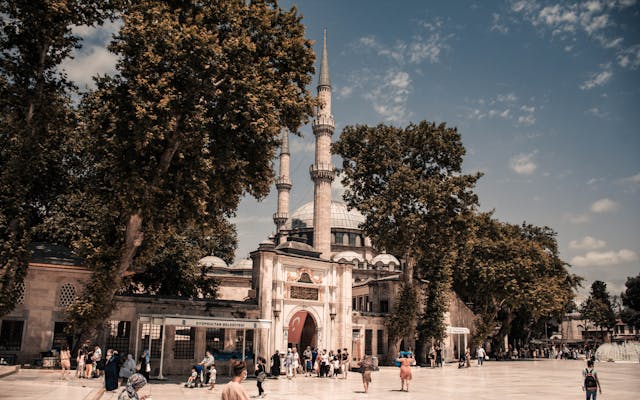
The Eyüp Sultan Mosque and Tomb: The Center of Worship and Visitation The Eyüp Sultan Mosque holds the distinction of being the first monumental mosque built after the conquest of Istanbul. The current mosque, rebuilt in the Baroque style in 1800 by Sultan Selim III after the original was destroyed in an earthquake, welcomes visitors with its majestic silhouette on the shores of the Golden Horn and its serene courtyard. However, the true heart is the Eyüp Sultan Tomb right next to the mosque. This tomb, visited by thousands of local and foreign tourists daily, is one of the most important sites of visitation in the Islamic world. Adorned with tiles, calligraphy, and hand-drawn decorations, the interior possesses a profound spiritual atmosphere. Visitors pray here, expressing their devotion and respect to a Companion who fell as a martyr in these lands out of love for the Prophet.
Culture and Social Life in Eyüp Sultan Eyüp Sultan is not only a religious center but also a vibrant cultural mosaic.
- Accession Ceremonies: In the Ottoman era, Sultans ascending the throne would come to Eyüp Sultan with statesmen and the public, where the Shaykh al-Islam would gird them with a sword. This "Ceremony of the Sword" tradition signified the spiritual confirmation of their authority to rule.
- A Lost Tradition: The Toymakers' Bazaar: Eyüp Sultan was once home to Istanbul's most famous toy shops. This bazaar, which became particularly lively in the 19th century, was renowned for toys made of wood, tin, and clay. The most characteristic of these toys were the "düdüklü testi" (whistling jug), earthenware whistles shaped like water jugs that produced a bird-like sound when blown. Families visiting the tomb with their children would make it a custom to buy a traditional toy, and these whistling jugs were among the most popular. The cheerful sounds of whistles rising from the bazaar as people left Eyüp Sultan added joy to the district's ambiance. Although this tradition has been lost to the modern toy industry, it holds an important place in Eyüp Sultan's colorful memory.
- Supplication and Prayers: Ramadan nights, holy nights (kandil), and Fridays bring a special excitement and spiritual intensity to Eyüp Sultan. The atmosphere here is unmatched anywhere else in Istanbul.
- Pierre Loti Hill: This hill overlooking the Golden Horn is an essential stop on any visit to Eyüp Sultan, both for its view and its tranquil café atmosphere.
- The Historic Bazaar and Food Stops: The historic bazaar starting from the mosque courtyard hosts visitors with a wide range of goods, from prayer beads and books to handicrafts and local delicacies. Foremost among these delicacies is a special type of pita bread called "Güveç." Named after the earthenware pots (güveç) it's baked in, this pita comes in varieties like minced meat, cheese, or diced meat. Baking in traditional ovens in earthenware pots gives it a unique flavor and texture. Visitors can find and enjoy these delicious pitas fresh and hot at any time of day, crowning their Eyüp Sultan trip with a gastronomic experience. Eyüp Sultan in Ramadan: A Spiritual Festival Especially during the month of Ramadan, Eyüp Sultan becomes one of the most frequented places by Istanbulites to break their fast. During Ramadan, it transforms into a lively spiritual center where a series of meaningful rituals are lived, not just fasting.
- Iftar in a Historic Atmosphere: The mosque courtyard and surrounding streets fill with thousands of people shortly before iftar. Families and groups of friends break their fast under centuries-old plane trees with the snacks they brought or iftar packages from nearby restaurants. The peace found here is an experience that adds a deeper sense of commemoration and worship, far beyond eating in a regular restaurant.
- Communal Iftar Tables: The "soup kitchen" (imaret) tradition of the Eyüp Sultan Complex comes to life here with large communal iftar tables. Hundreds of people break their fast together with prayers at the cannon fire on the same table, witnessing the most tangible form of the spirit of sharing and brotherhood in Islam.
- The Joy of Tarawih: After iftar, the crowd filling the mosque and its surroundings prepares for the Tarawih prayer. The recitation of the imam and the congregation's "amin" echoes from the Golden Horn, creating an unforgettable spiritual atmosphere.
- Ramadan Flavors: The historic bazaar becomes a place of feast during Ramadan. Restaurants and stalls offering traditional pitas, güllaç (a milk dessert), and sherbets cater to large crowds before and after iftar.
Conclusion: An Oasis of Serenity Beyond Time Eyüp Sultan is an oasis of serenity where time seems to stand still, amidst the crowd, noise, and hustle of Istanbul. On one hand, the silence of thousands resting under the shade of centuries-old trees, including pivotal figures of Ottoman history, and on the other, the sound of prayers rising from the tomb and the Qur'anic recitation from the mosque... This contrast adds a unique depth to Eyüp Sultan. The extraordinary spiritual vitality experienced especially on Ramadan nights transforms it from an ordinary site of visitation into a living treasure of faith. It is not merely the location of a Companion's grave, but the most concrete expression of a civilization molded by faith. Anyone visiting Istanbul must, after seeing the splendor of Hagia Sophia and the richness of Topkapi, stop by Eyüp Sultan to understand the soul of this city and leave carrying a trace of its unique peace and spirituality in their heart.
Last Modification : 10/17/2026 3:31:14 AM