Çırağan Palace
On the European shore of the Bosphorus in Istanbul, amidst the magnificent silhouette stretching between Beşiktaş and Ortaköy, there stands a structure that stands out from the others: Çırağan Palace. This magnificent building, whose history dates back to the 17th century, is not merely an Ottoman palace; it is also a unique cultural heritage that witnessed the final period of the empire, was reduced to ashes by fire, remained in ruins for years, and ultimately rose from its ashes to become one of the world's prestigious luxury hotels. This article will explore the enchanting story of Çırağan Palace from the Tulip Era to the present day, its architecture, and its transformation.
I. The Origin of a Name: From the Tulip Era to the First Structure
The story of Çırağan begins long before the current magnificent palace. Known as the "Kazancıoğlu Gardens" in the 17th century, this area was arranged as an imperial garden (hasbahçe) during the reign of Sultan Ahmed I, and Murad IV gifted it to his daughter Kaya Sultan, laying the foundation for future construction in the area. The real turning point came during the Tulip Era (1703-1730). The reigning Sultan Ahmed III gifted his land here to his son-in-law and grand vizier, Nevşehirli Damat İbrahim Pasha. İbrahim Pasha had a wooden waterside mansion (yalı) built here for his wife, Fatma Sultan. This mansion became famous for the entertainments held there. The night festivities, where the gardens were illuminated by thousands of oil lamps and torches, became so renowned that the Persian word "Çerağân," meaning "lights," gave its name to this area and, consequently, to the future palace. During this period, Çırağan, with its oil lamps on one side and colorful tulips on the other, was like a scene straight out of the Arabian Nights.
II. Construction of the Current Palace: The Balyan Family and Sultan Abdülaziz's Dream
The wooden structure, used by various sultans over the years, was rebuilt during the reign of Sultan Mahmud II (1834), but the major transformation occurred during the time of Sultan Abdülaziz (1861-1876). Sultan Abdülaziz, dreaming of a structure even more magnificent than Dolmabahçe Palace, commissioned the famous Ottoman-Armenian architect family, the Balyan Family (Nigoğos, Sarkis, and Agop Balyan), to build a new palace. Construction of the new Çırağan Palace began in 1863 and was completed in 1871, costing a total of 2.5 million gold liras. Materials used in the structure were brought from all corners of the world; alabaster from Egypt, marble from Italy, and porphyry stones from Africa adorned the palace walls. Each of the palace's mother-of-pearl inlaid, masterfully crafted wooden doors cost a thousand gold pieces; one of these doors was gifted by Sultan Abdülhamid II to German Emperor Wilhelm II, who greatly admired the palace. In terms of architectural style, Çırağan belongs neither entirely to European nor Asian architecture. It is considered one of the most important examples of the popular Orientalist style of the period. The colored marble workmanship on the exterior, the monumental gates, and the elegant marble bridge connecting to Yıldız Park at the rear are among the palace's most striking features. Inside, walls covered with white, pink, and green marble, the 14-meter-high "Hall with Columns" (Direkli Salon), and paintings by famous artists of the period dazzle visitors.
III. The Shadow of a Legend: The Beşiktaş Mevlevi Lodge
The magnificent story of Çırağan Palace also has a spiritual dimension, one that adds a tragic depth to the palace's history. Legend has it that the land on which Sultan Abdülaziz built this magnificent palace was not empty. In this area stood the Beşiktaş Mevlevi Lodge (Beşiktaş Mevlevîhânesi) , one of the important Sufi centers of the Ottoman Empire. Mevlevism was a deeply rooted Sufi order, highly respected in Ottoman society and court circles, intertwined with tolerance, music, and poetry. The Beşiktaş Mevlevi Lodge held an important place in the spiritual fabric of Istanbul. Sultan Abdülaziz needed the land where this lodge stood to expand his palace and achieve its current grandeur. Historical records indicate that the lodge was relocated to an area near the Vişnezade Mosque in today's Beşiktaş Abbas Ağa neighborhood. However, according to popular narratives and some historical accounts, this relocation was not enough to win the hearts of the dervishes. The story goes that the dervishes at the lodge were not content with having these sacred lands, whose spiritual atmosphere they had elevated for centuries through prayer and worship, taken from them for palace construction. According to legend, it was believed that no structure built on this land without winning the dervishes' consent, without their blessing, would bring good fortune, and that those living here could not be happy. This narrative settled over Çırağan Palace like a story of a "curse" or "misfortune." The rumor that "everyone living in this palace, built without winning the hearts of the dervishes, would meet a bad end" grew stronger with the tragic events that occurred shortly after the palace's completion.
IV. Those Left in the Shadow of Magnificence: Murad V's 28 Years of Imprisonment
When the palace was completed, Sultan Abdülaziz did not live in this magnificent structure for long. Shortly after being dethroned in 1876, he was found dead in Çırağan Palace on May 30, 1876. Although official records state it was suicide, there are strong claims that he was murdered. According to one account, Abdülaziz, after being dethroned, was brought to this palace, confined to a room, and found dead shortly thereafter with his wrists slashed. This tragic end was interpreted as the first sign of the dervishes' curse. His nephew, Murad V, who succeeded him, became one of the palace's most tragic inhabitants. After reigning for only 93 days, he was dethroned on the grounds of mental instability and confined to Çırağan Palace with his family. Thus, the palace, in a rare occurrence in the world, functioned as a "magnificent prison" for a sultan for 28 years. During these long years of captivity, Murad V found solace in music and composed hundreds of pieces at his piano. Murad V, who passed away here in 1904, is still commemorated within the palace today; in 2012, an opera-ballet piece composed of his works was performed for the first time within the walls of Çırağan Palace.
V. The Period of Fire and Ruins
After the proclamation of the Second Constitutional Era, the palace began to be used as the building for the Chamber of Deputies (Meclis-i Mebusan) in 1909. However, this transformation was short-lived. On January 19, 1910, a terrible fire, believed to have started from a radiator flue in the attic, reduced the palace to ashes in just five hours. The fire destroyed the valuable collection of paintings by famous artists like Rembrandt and Aivazovsky, brought from Sultan Abdülhamid II's Yıldız Palace, along with Murad V's library of thousands of books. Among the people, this fire was also attributed to the dervishes' curse. It was believed that since the dervishes' lands of worship were taken, and now this palace, having ceased to be a place of worship, was being converted into a parliament building, such a structure could not endure on this land; the fire was seen as divine punishment. Only the magnificent outer walls remained after the fire. The palace grounds, left in ruins for many years, were used for various purposes during the Republican era. For a time used by French occupation forces as the "Bizo Barracks," the ruins were allocated to Beşiktaş Gymnastics Club in the 1930s and transformed into a football field named Şeref Stadium. For years, football matches were played on this historic land by the Bosphorus.
VI. Rebirth from the Ashes: New Life as a Hotel
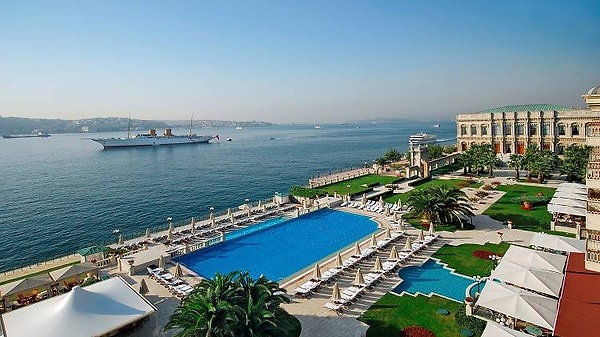
The rebirth of Çırağan Palace occurred in the late 1980s. In 1987, a major restoration project was initiated by the Japanese Kumagai Gumi and Turkish Yüksel İnşaat partnership. Along with meticulously restoring the historic palace while preserving its original walls, a modern hotel building was added to its gardens. The hotel section opened its doors in 1990, and the historic palace section in 1992. Today, the structure, serving as Çırağan Palace Kempinski Istanbul, is operated by Kempinski, one of Europe's oldest luxury hotel chains. As of 2025, the hotel celebrates its 35th year under Kempinski management. Just as in the past, it continues to host royal families, heads of state, famous artists, and leading figures from the business world. Within the hotel, "Historical Corridor Tours" are organized, allowing visitors to explore original sections like the Sultan's Hamam (Hünkâr Hamamı), offering guests the opportunity to experience Ottoman magnificence up close.
Çırağan Palace is a witness on the shores of the Bosphorus that has defied centuries. Its walls hold countless stories: from the fairy-tale entertainments of the Tulip Era to the sorrowful events of the empire's decline, from destruction by fire to rebirth as a modern hotel. However, beyond all these stories, there lies a spiritual legend at the palace's foundations: the belief that everyone who lived in this palace, built without winning the hearts of the dervishes of the Beşiktaş Mevlevi Lodge, would meet a bad end. The mysterious death of Sultan Abdülaziz, Murad V's 28-year imprisonment, and the subsequent fire disaster are etched in memory as events that strengthened this legend. Today, one of Istanbul's most prominent landmarks, Çırağan is a rare place that blends Ottoman heritage with modern luxury, keeping the city's cultural memory alive. It is not merely a hotel or a historical monument, but the eternal representative of a name dancing with lights, a magnificent dream, a will rising from the ashes, and perhaps the silent cry of the dervishes whose hearts were never won.
Last Modification : 4/18/2026 10:46:12 AM