The Evil Eye Bead
the-evil-eye-bead
A Silent Guardian and Cultural Ambassador
🧿 A Silent Guardian and Cultural Ambassador
Throughout human history, the eye has symbolized both seeing and being seen. To look is not merely to observe—it is to understand, to judge, even to dominate. That’s why the eye has held a sacred yet dangerous place in many cultures. The evil eye bead, or nazar boncuğu, stands at the intersection of these meanings: it watches like an eye, but shields against harmful gazes.
Though it seems to have originated in Anatolia, the evil eye belief stretches back to ancient Mesopotamia, Egypt, and Greece. People have long believed that envious glances, hidden resentment, and unconscious ill will carry a kind of energy—one that can make children sick, disturb homes, and disrupt fortunes. To counter this invisible threat, they created a symbolic defense: the evil eye bead.
🧿 From Medusa to Nazar: A Symbolic Evolution
In Ancient Greek mythology, Medusa was a Gorgon whose gaze could turn people to stone. Her severed head was often used as a protective emblem, placed on shields, buildings, and jewelry to ward off evil. The idea was simple: fight gaze with gaze. This concept of a powerful, protective eye carried through centuries and cultures.
In Turkish and Islamic traditions, however, the depiction of full human faces—especially in religious or spiritual contexts—was discouraged. As a result, the protective symbol evolved into a more abstract form: the eye alone. The nazar boncuğu became a distilled version of Medusa’s gaze—stripped of the face, but retaining the power of sight. It is a cultural adaptation that reflects both continuity and transformation: the eye remains, but its form is shaped by belief.
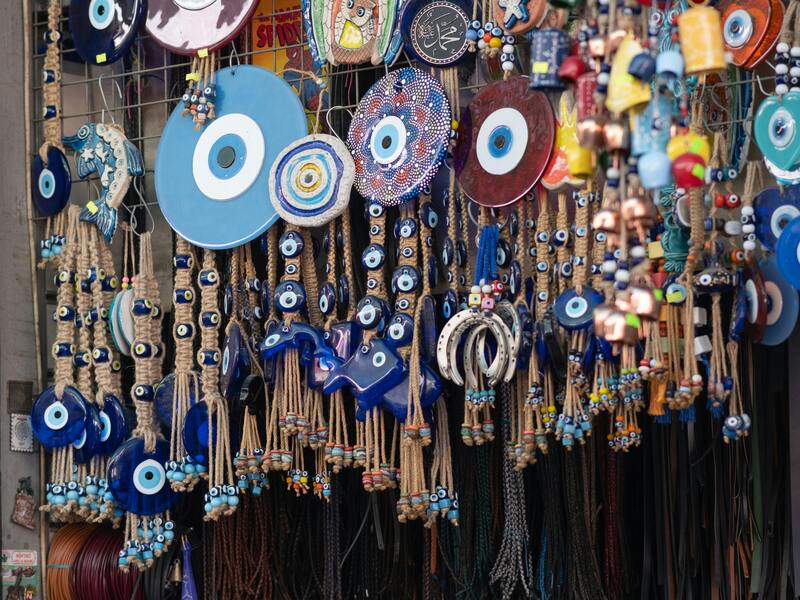
Made of glass, typically blue, with a central eye motif, the bead is a silent guardian. It hangs at doorways, is pinned to newborns’ pillows, dangles from car mirrors, and wraps around wrists. It’s everywhere, yet it never speaks. It simply watches. But its gaze is protective. When met with malevolent eyes, it absorbs, diffuses, and neutralizes their effect. That’s why people say, “If the bead cracked, it took the evil eye.” Its breaking is seen as proof of its fulfilled duty.
Yet the evil eye bead is more than a talisman—it’s a cultural identity. For someone living in Turkey, it’s a childhood bracelet tied by a mother, a glass charm hanging at a grandfather’s door, a colorful trinket sold in local bazaars. It’s also an aesthetic object. The calming blue, the shine of glass, the symmetry of the eye—all combine to create something both meaningful and beautiful.
The Evil Eye in Tourism: A Glass Memory of Culture
For tourists visiting Turkey, the evil eye bead is more than a decorative item—it’s a cultural symbol. Found in the Grand Bazaar, seaside souvenir shops, airport boutiques, and hotel lobbies, it’s everywhere. When a tourist buys one, they’re not just taking home a piece of glass—they’re carrying a fragment of Turkey’s spirit.
Some wear it as jewelry, others hang it in their homes, and some simply keep it as a keepsake. But nearly all ask the same question: “What does this mean?” And in that moment, the bead ceases to be a souvenir—it becomes a storyteller. It represents Turkey’s beliefs, traditions, aesthetic sensibilities, and its people’s respect for the unseen.
In today’s world, the evil eye bead is no longer just a protective charm—it’s a symbol of identity. It appears in restaurant logos, fashion designs, and social media profiles. It has even entered the digital realm as an emoji: 🧿. This shows its evolution into a universal symbol, transcending cultural boundaries. Yet within every bead lies a trace of Anatolia, a whisper of belief, and a quiet reverence for the invisible.
The evil eye bead is far more than a piece of glass. It is a symbolic shield against inner fears. A visible good against invisible harm. Silent, yet meaningful. And perhaps most importantly, it still tries to tell us something. While it protects our eyes, it reminds us to guard our hearts. For the tourist, it’s a memento; for the local, a belief. But for everyone, it’s a shared symbol: the nazar boncuğu—a modern echo of Medusa’s gaze, shaped by faith, culture, and centuries of silent watching.
Last Modification : 10/16/2026 3:07:27 AM