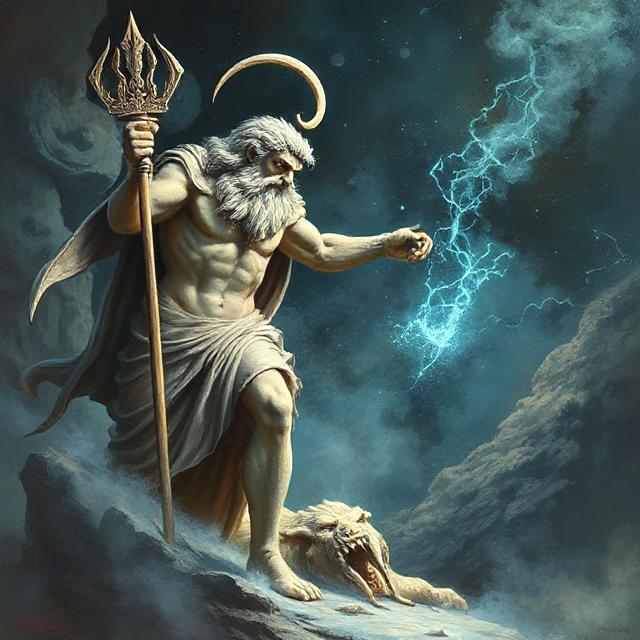
Zeus and Typhon
In Greek mythology, Zeus, the king of the gods, fought countless battles to solidify his power. Yet none were as fierce as his clash with Typhon, the monstrous creation of Gaia, born from her desire for vengeance. This myth is more than just a physical confrontation—it symbolizes the eternal struggle between order and chaos.
Typhon: The Nightmare of the Gods
After the defeat of the Titans, Gaia, consumed by rage against the Olympian gods, united with Tartarus to create Typhon. This creature stands as one of the most terrifying beings in mythology. His head touches the heavens, his arms stretch from one end of the world to the other. With every step, the earth trembles; his breath unleashes storms. Typhon embodies chaos—disrupting order, erasing boundaries, and overturning all that exists.
The First Battle: Zeus’s Downfall
When Typhon marched upon Olympus, the gods were seized with terror. All fled in fear, transforming into animals to escape. Only Zeus stood firm, wielding his thunderbolts against the colossal beast. At first, his thunder and lightning forced Typhon back, but the monster’s immense strength proved overwhelming. In close combat, Typhon ensnared Zeus in his crushing grip, rendering him powerless. Worse still, he severed Zeus’s sinews, stripping him of his strength, and imprisoned him in a cave in Cilicia.
The Olympian Scheme: Zeus’s Resurrection
Zeus’s defeat meant the universe teetered on the brink of chaos. Yet the Olympian gods refused to surrender. Hermes and Aegipan stealthily retrieved Zeus’s stolen sinews and restored them to him. Regaining his strength, Zeus reclaimed his thunderbolt and prepared for vengeance.
The Final Battle: The Triumph of Order
When Typhon discovered Zeus had escaped, his fury knew no bounds. The two clashed once more, but this time, Zeus held the strategic advantage. With his thunderbolts, he struck Typhon down and cast him into the depths of Tartarus. Thus, chaos was vanquished, and order prevailed.
Mythological and Symbolic Interpretation
This tale represents the triumph of order (cosmos) over chaos (khaos) in ancient Greek thought. Zeus’s victory ensures the balance of the universe. It also highlights the power of cunning and cooperation, for Zeus did not win alone—his allies played a crucial role.
To this day, the myth resonates across art, literature, philosophy, and popular culture. Stories like this remind us that the struggle against chaos is never-ending. Zeus’s victory over Typhon is not just the triumph of a god—it is the triumph of order and reason.
Last Modification : 10/16/2026 3:51:21 AM