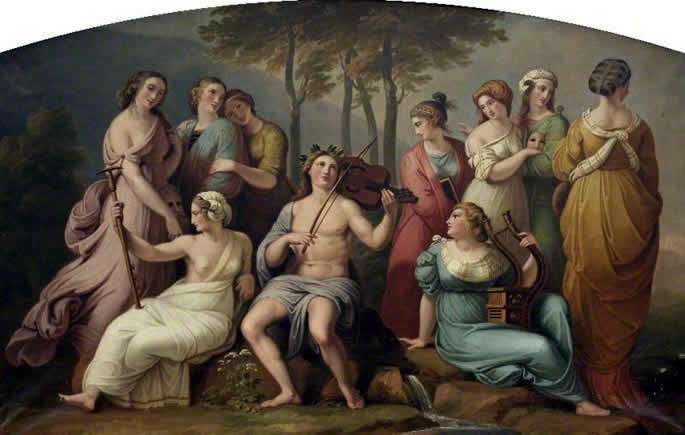
Theogony of Hesiod
The ancient Greek world’s understanding of divine origins and the creation of the cosmos is profoundly shaped by Hesiod’s Theogony, a monumental poetic work composed around the 8th century BCE. Hesiod, a poet from the region of Cyme (modern-day Aliağa in Turkey), provides one of the most systematic accounts of how the gods came into being, their genealogies, and the establishment of cosmic order. Unlike Homer, who focused on heroic epics, Hesiod’s work delves into theology, cosmology, and the moral framework of the Greek world.
What makes Theogony particularly fascinating is not just its mythological content but also its narrative framing—Hesiod claims divine inspiration from the Muses (Mousai), positioning himself as a chosen vessel of sacred knowledge. This aspect invites comparisons with prophetic traditions in monotheistic religions, where divine messengers convey truths to humanity. By examining Hesiod’s account, we gain insight into how ancient Greeks conceptualized the universe, divinity, and human existence.
Hesiod and the Divine Inspiration of the Muses
Hesiod begins Theogony with a hymn to the Muses, the nine daughters of Zeus who preside over the arts and knowledge. He describes an encounter with them on Mount Helicon, where they bestow upon him the gift of poetry and divine wisdom:
"They breathed into me a divine voice, so that I might celebrate things of the past and of the future."
This moment is crucial—it mirrors the concept of divine revelation found in many religious traditions. Just as biblical prophets received visions from God or Muhammad received the Qur’an through the Angel Gabriel, Hesiod presents himself as an intermediary between the gods and mortals. The Muses, in this context, function like angelic beings, transmitting sacred knowledge that would otherwise remain inaccessible to humans.
Hesiod’s self-presentation as a divinely inspired poet raises intriguing questions: Was he asserting his authority as a theologian? Was he attempting to legitimize his narrative by claiming divine sanction? Or was he, like many ancient poets, embedding his work within a tradition of sacred storytelling? Whatever the case, his invocation of the Muses underscores the religious significance of his poetry.
Chaos: The Primordial Beginning
Hesiod’s cosmology begins with Chaos (Khaos), a term often translated as "void," "abyss," or "gaping emptiness." Unlike later philosophical interpretations of chaos as mere disorder, Hesiod’s Chaos is a primordial, generative force—the first entity to emerge in existence:
"First of all, Chaos came to be..."
From Chaos arise other fundamental cosmic forces:
- Gaia (Earth), the solid foundation of the world.
- Tartarus, the deep abyss beneath the earth.
- Eros, the force of attraction and procreation.
- Erebus (Darkness) and Nyx (Night), representing primordial darkness.
This sequence reflects an early attempt to explain the origins of the universe through personified natural forces—a common feature in ancient mythologies.
Comparative Mythology: Chaos and Cosmic Waters
Hesiod’s Chaos finds parallels in other ancient creation myths, particularly those from Mesopotamia and Egypt:
1. Mesopotamian Mythology (Enuma Elish & Sumerian Traditions)
The Babylonian creation epic Enuma Elish begins with the mingling of Apsu (freshwater) and Tiamat (saltwater), representing primordial chaos.
Similarly, Sumerian myths describe Nammu, the primeval sea, as the mother of all gods.
2. Egyptian Mythology
The Heliopolitan creation myth starts with Nun, the infinite, dark waters from which the first land (the benben mound) emerges.
3. Biblical Parallels
Genesis 1:2 describes the earth as "formless and void" (Hebrew tohu wa-bohu), with the "Spirit of God hovering over the waters."
This suggests a shared Near Eastern motif where creation emerges from a watery, chaotic abyss.
The recurrence of water or void as the starting point in these myths may reflect both cosmological observations (the importance of water for life) and psychological archetypes (the unknown as a source of both fear and potential).
The Rise of the Gods: Generational Struggles and Cosmic Order
Hesiod’s Theogony is not just a creation story but also a chronicle of divine succession. The Greek gods do not emerge peacefully—each generation overthrows the previous one in a struggle for power:
- Uranus (Sky) and Gaia (Earth) produce the Titans, but Uranus suppresses them out of fear. His son Cronus castrates him, seizing power.
- Cronus, fearing a similar fate, devours his children, but Zeus escapes and overthrows him.
- Zeus defeats the Titans and Typhoeus, establishing Olympian rule.
This pattern of divine conflict mirrors Near Eastern myths like the Hittite Kumarbi Cycle and the Babylonian Enuma Elish, where younger gods overthrow older ones. These stories may symbolize natural phenomena (e.g., the displacement of older cults by new ones) or philosophical ideas about cyclical time.
Zeus and the Establishment of Cosmic Justice
Unlike his predecessors, Zeus does not rule through brute force alone. With the advice of Metis (Wisdom) and Themis (Divine Law), he establishes Dike (Justice), ensuring that the cosmos operates under moral and legal principles. This shift from raw power to ordered governance reflects Greek ideals of civilization and rationality.
The Role of Humanity in Hesiod’s Cosmology
Unlike later Abrahamic traditions, where humans are central to creation, Hesiod’s Theogony focuses primarily on the gods. However, his other work, Works and Days, describes human origins through the myth of the Five Ages of Man, where humanity degenerates from a Golden Age to the present Iron Age.
This pessimistic view contrasts with the Theogony’s emphasis on divine order, suggesting that while the gods have achieved stability, humans remain flawed and distant from the divine.
Hesiod’s Legacy in Myth and Philosophy
Hesiod’s Theogony is more than a collection of myths—it is a foundational text that shaped Greek religious thought, philosophy, and literature. Its themes resonate across cultures:
The struggle between chaos and order.
The transition from divine tyranny to just rule.
The role of wisdom in governance.
Later philosophers, such as the Pre-Socratics, would reinterpret Hesiod’s myths in naturalistic terms (e.g., Thales’ claim that "all things are from water" echoes primordial ocean myths). Even Plato, though critical of poetic myths, engaged with Hesiodic themes in his cosmology.
Ultimately, Theogony stands as a bridge between myth and reason, offering timeless insights into humanity’s quest to understand the origins of the cosmos and our place within it.
Hesiod’s work reminds us that mythology is not just "ancient storytelling" but a profound attempt to grapple with existence itself. Whether through Chaos, the Muses, or Zeus’ reign, Theogony articulates a vision of the universe that continues to inspire and challenge readers millennia after its composition.
Last Modification : 10/16/2026 3:06:04 AM