Polyxena, one of the most tragic figures in Greek mythology, was the youngest daughter of King Priam and Queen Hecuba of Troy. Her story is a poignant narrative that reveals the brutality of the Trojan War and the cruelty of the victorious Achaeans in its aftermath. Polyxena does not appear in Homer's Iliad; her story was penned by later poets and playwrights, perhaps to add romantic and tragic elements to Homer's stark narrative. This article aims to examine Polyxena's sorrowful end in all its aspects, focusing on the course of the Trojan War and the complex relationship between the legendary warrior Achilles and Polyxena.
The Trojan War and the Role of Achilles
The Trojan War was a ten-year-long bloody struggle that began when the Trojan prince Paris abducted Helen, the wife of King Menelaus of Sparta. The Achaean army, gathered from all corners of Greece, laid siege to Troy. The most important and deadly warrior of this army was undoubtedly Achilles, son of Peleus. Considered invincible except for his fatal weakness, which gave rise to the phrase "Achilles' heel," this hero was the most critical figure determining the fate of the war.
Achilles' first encounter with Polyxena occurs early in the war. According to a prophecy, Troy would never fall if Polyxena's brother Troilos reached the age of twenty. Learning of this prophecy, Achilles ambushes Troilos and Polyxena while they are drawing water at a spring. After brutally killing Troilos, Achilles is struck by Polyxena's calm demeanor and beauty.
The Complex Relationship Between Polyxena and Achilles
Achilles' interest in Polyxena deepens over time. Still unable to overcome the pain of his friend Patroclus' death, Achilles finds solace in Polyxena's words. According to some accounts, a closeness develops between the two young people, and Achilles, trusting Polyxena, mentions his only weak spot—his heel. It is believed that Polyxena passed this information on to her brothers Paris and Deiphobus.
As events progress, Achilles is offered marriage to Polyxena in exchange for making peace with Troy. However, for this marriage to take place, Achilles must withdraw the Greek army from the war and Helen must be returned to the Greeks. When Achilles goes to the Temple of Apollo to meet Polyxena to finalize the agreement, he is ambushed by Paris. Polyxena's brother Paris emerges from hiding in the temple, strikes Achilles in the heel, and kills the legendary hero. Some sources state that Apollo himself guided this arrow.
The Sacrifice of Polyxena
At the end of the Trojan War, the city falls through Odysseus' wooden horse strategy. Priam, Hector, and many other Trojan warriors have been killed; the women have been gathered to be distributed as spoils. It is at this moment that the ghost of the deceased Achilles appears at his tomb and demands a prize from the Greeks: the sacrifice of Polyxena. Achilles' spirit declares that only if this sacrifice takes place will he send the winds allowing the Greek fleet to leave Troy and set sail.
This scene, described in detail in Euripides' plays Hecuba and The Trojan Women, is one of the most powerful moments in ancient literature. The Greek army gathers at Achilles' tomb. Achilles' son Neoptolemus (Pyrrhus), holding a golden cup, makes an offering to his father and, with the army's support, prepares to sacrifice Polyxena.
At this point, Polyxena's attitude sets her apart from the ordinary victims of mythology. Preferring to die like a princess rather than be captured and live as a slave, Polyxena offers no resistance. On the contrary, she tells the soldiers holding her to release her, tears her garment to bare her chest, and turns to Neoptolemus, uttering these shocking words: "Look! If you are eager to strike this chest, young Neoptolemus, strike now—or if you wish to cut my neck, here is my throat ready."
Even Neoptolemus hesitates for a moment in the face of this courageous stance, but ultimately plunges his sword. Polyxena preserves her honor even in death; as she falls, she arranges her garment to cover the parts that should be hidden from view. In Seneca's play Troades, it is recounted that Polyxena falls to the ground with anger, intending by this fall to add weight upon Achilles' tomb.
Archaeological Evidence: The Polyxena Sarcophagus
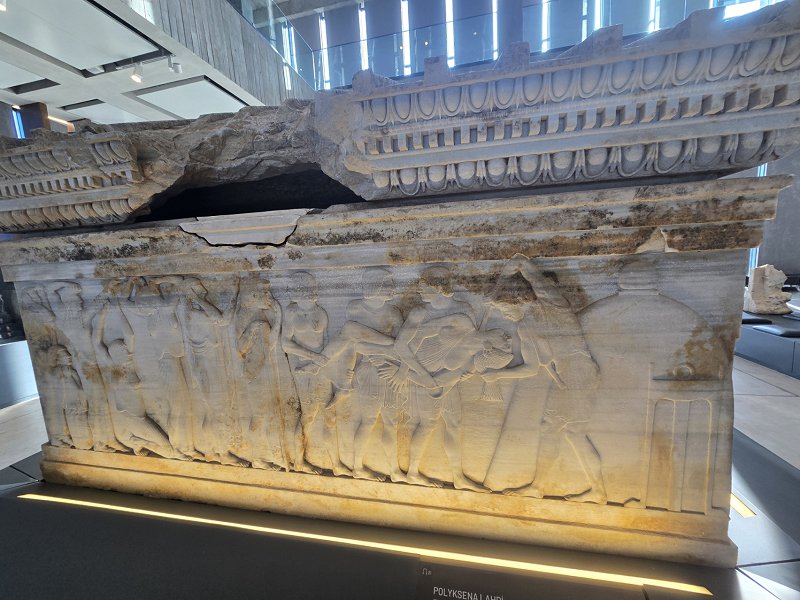
One of the most tangible pieces of evidence for Polyxena's tragic story is the Polyxena Sarcophagus, now exhibited at the Troy Museum in Çanakkale. Discovered in the Kızöldün Tumulus near Biga in 1994, this sarcophagus holds the distinction of being the oldest known stone sarcophagus with figured reliefs in Anatolia. Dating to 500-490 BC, this artifact is an early example of the Prokonnesos marble workshops.
Different scenes are depicted in reliefs on the four sides of the sarcophagus. While a funeral ceremony is portrayed on three sides, the back side depicts Polyxena's sacrifice by Neoptolemus in front of Achilles' tomb. On one side panel, Polyxena's mother Hecuba is seen crouched under a leafless tree, mourning her daughter's death. Although the majority of the figures in the reliefs are women, the bones of a man around forty years of age were found inside the sarcophagus. This indicates that although the sarcophagus features mythological scenes, it was made for a real person. A hole in the lid of the sarcophagus suggests that the artifact was looted in antiquity.
Different Narratives and Interpretations
There are also different versions of Polyxena's death. Some sources claim that Polyxena committed suicide out of guilt for her role in Achilles' death. Philostratus writes that she voluntarily threw herself upon the sword because of her love for Achilles. Hyginus recounts that Polyxena was sacrificed when a voice from Achilles' tomb demanded its share, as she was considered part of the spoils.
The common point of these different narratives is Polyxena's noble stance in the face of death. King Agamemnon's opposition to the sacrifice, yet his eventual retreat in the face of the seer Calchas' prophecy and the army's pressure, sheds light on the tradition of human sacrifice and superstitions of the era.
The Sacrifice of Polyxena in Art
Polyxena's tragic death has inspired many works of art from ancient times to the present day. Beyond the Polyxena Sarcophagus, according to Pausanias' account, a painting on the Athenian Acropolis depicted Polyxena about to be sacrificed near Achilles' tomb.
Interest in the subject was revived during the Renaissance and Baroque periods. Artists such as Pietro da Cortona, Charles Le Brun, and Giovanni Battista Pittoni depicted the sacrifice of Polyxena on large canvases. Most of these works emphasize Polyxena's dignified stance; she is portrayed as a princess maintaining her nobility even while going to death, with her chest bared.
The sculpture signed by Pio Fedi (1855-1865) exhibited in the Loggia dei Lanzi in Florence is often called "The Rape of Polyxena," but the word "rape" here comes from the Latin verb "rapere" (to seize, carry off), and the sculpture depicts the moment Neoptolemus seizes Polyxena to take her away for sacrifice.
Polyxena's story is a striking example of the cruel logic of the Trojan War and the tragic fate of women in its aftermath. With her love for Achilles or her betrayal on one hand, and her heroic stance in the face of death on the other, Polyxena stands out as one of the most complex female characters of the ancient world.
Her story combines two great themes of Greek tragedy: the senseless brutality of war and the individual's dignified stance against fate. Polyxena, as the Trojan counterpart of Iphigenia, creates a tragic symmetry between a young girl sacrificed at the beginning of the war and another sacrificed at its end. Her story has persisted through the centuries as a powerful narrative demonstrating that human dignity and nobility can still exist in the shadow of a war where even the victors lose their humanity. The Polyxena Sarcophagus, exhibited today at the Troy Museum, awaits visitors as a visual witness to this ancient tale and maintains its significance as one of the rare artifacts where mythology meets reality.