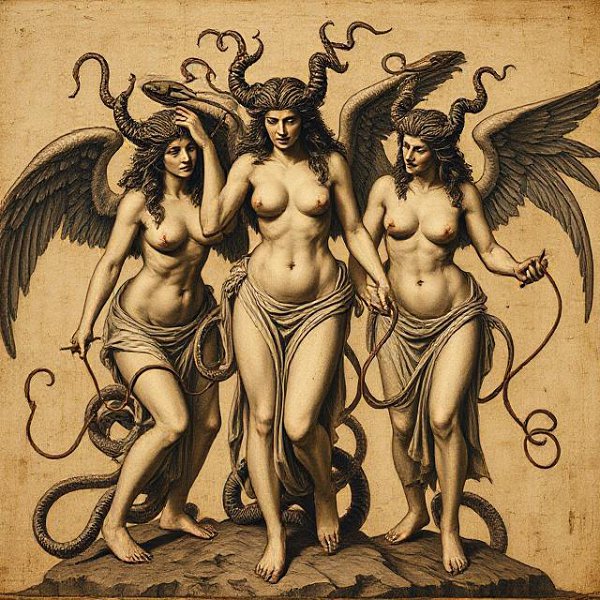
They arose from the first divine blood spilled upon the earth—a scream given form. When the dark drops from Uranus’ severed flesh seeped into Gaia’s womb, they took shape as the manifestation of a prehistoric concept of justice. The Erinyes were not mere figures of myth but the embodied essence of a primal understanding of justice etched into humanity’s collective memory.
The myth that began with Cronus castrating his father was, in truth, a metaphor for a universal cycle: crime, punishment, and rebirth. The Erinyes were the guardians of this cycle. For them, justice was not a human concept but a matter of cosmic balance. Any being—god or mortal—who broke the laws had to pay the price to restore that balance.
Depicted in ancient Greek art with serpents coiled in their hair, winged bodies, and whips in hand, these beings did not merely inflict pain upon their victims—they forced them to confront the truth. The madness they inflicted was less a punishment than an inevitable reckoning, a mirror held up to the guilty. In ancient tragedies, those pursued by the Erinyes grappled not only with divine wrath but with the turmoil within their own souls.
Though known as protectors of social order, the Erinyes’ justice was not bound by human morality. What mattered to them was the violation of the sacred. A mother’s murderer, a guest betrayed, or a mortal who dared challenge the divine order with hubris—all were deserving of these primordial forces’ fury. In ancient Greece, this transgression, called hubris—the arrogance of defying the divine—provoked the Erinyes’ most brutal interventions.
Reinterpreting the Erinyes today may require understanding the evolution of justice itself. While modern legal systems promise cold, rational justice, the Erinyes remind us of a justice that is raw and impassioned. Perhaps every era has its own Erinyes: today, cancel culture and digital mobs wield the whips of vengeance in their own way.
Ultimately, the myth of the Erinyes reflects the contradictions in humanity’s pursuit of justice. What is the purpose of punishment? Does vengeance achieve justice, or does it merely perpetuate a new cycle? These questions, posed millennia ago, still await an answer.