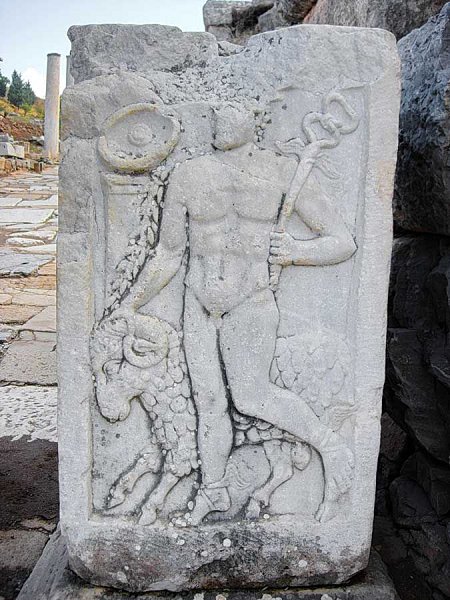
Hermes
Hermes, one of the most colorful and versatile figures in Greek mythology, is the god of thieves, merchants, travelers, and messengers. His endowment with these unusual traits is explained by his intriguing birth story and the deeds he performed while still in his cradle.
A Birth Hidden in a Cave
Hermes' mother is Maia, one of the daughters of the Titan Atlas, a nymph who lived in the mountains of Arcadia. While everyone was asleep, Maia lay with Zeus and became pregnant with Hermes. Fearing the jealousy and wrath of Zeus's wife, Hera, she was forced to give birth in secret within a remote cave. Hermes was born on the fourth day of the month, a date which became a day of celebration in his honor in ancient Greece.
The Thief from the Cradle
But Hermes was no ordinary baby. The precociousness he displayed immediately after his birth made him one of mythology's most unforgettable characters. On the night he was born, the swaddled infant slipped out of his cradle and journeyed to where Apollo's herds were grazing in Thessaly. He skillfully stole a portion of the animals. Along the way, he found an empty tortoise shell, stretched gut strings across it, and invented the first lyre. After hiding the stolen animals in a cave along with his new instrument, he returned to his cradle undetected and pretended to be an innocent, sleeping baby.
A Herd in Exchange for a Lyre
When morning came, Apollo noticed the missing cattle and, after a brief investigation, deduced that the culprit was his newborn half-brother, Hermes. At first, no one took such an accusation seriously, but the truth quickly came to light, and Hermes was forced to confess where he had hidden the animals.
When Apollo went to the cave to retrieve his herd, he saw the lyre Hermes had made. Touching it, he was mesmerized by the enchanting sound it produced. Apollo, the god of music and art, immediately offered to trade his entire herd for the lyre. Hermes accepted the deal.
The Flute and the Magic Staff
While tending the herds he had gained, Hermes once again demonstrated his innovative spirit. This time, he invented the syrinx, a flute made from seven reeds (also known as pan pipes). When Apollo heard the deep and captivating melodies he played, he wanted to possess this instrument as well. He struck another bargain with Hermes and, in exchange for the flute, gave him the Kerykeion (herald's staff, or caduceus). This magic staff became one of Hermes's most iconic symbols as the messenger of the gods and the patron of commerce.
The Two Sides of a God
These stories explain why Hermes is associated with two seemingly contradictory attributes:
- God of Thieves: His innate cunning, skill, and ability to cross boundaries made him the patron of thieves.
- God of Merchants: His knack for negotiation, profiting from deals, and his role in the exchange of goods (the herds) made him the patron of trade and merchants.
Hermes's adventure is not just a story of theft but also a triumph of intelligence, innovation, and communication. Through his invention of the lyre and flute, he represents art; through his deals, trade; and through his role as a messenger, the dialogue between gods and men, securing his indispensable position on Olympus.
Last Modification : 10/17/2026 5:06:49 AM