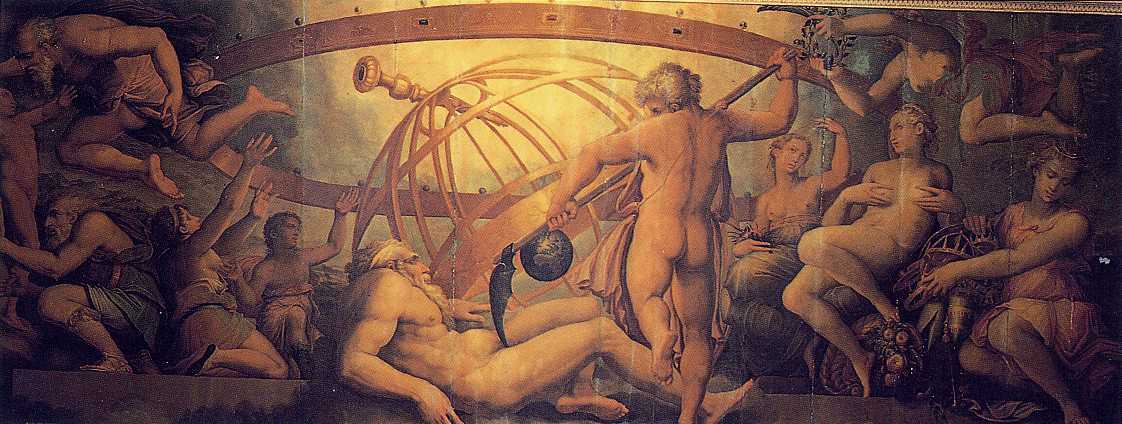
Gaia, Uranus
Mythology is like a mirror reflecting the depths of humanity's collective unconscious. In the Greek creation myths, the first entities to emerge after Chaos—Gaia (Earth) and Eros (Love)—shape the fundamental dynamics of existence. However, these dynamics encompass not only a physical order but also the roots of psychological and gender-based tensions. Gaia’s loneliness is not alleviated by the presence of Eros, for Eros is a force that accompanies the feminine creator but does not "complete" her. This gives rise to the myth’s central conflict: the struggle between feminine creativity and masculine control.
GAIA’S LONELINESS AND THE BIRTH OF URANUS
To ease her solitude, Gaia first creates Uranus (the Sky). Uranus is not merely the sky but also a lover who envelops her, perpetually united with her. As described in Hesiod’s Theogony, there is no void between them; Uranus spreads over Gaia like a blanket, embracing her. This union is not only physical but symbolic: the fertile feminine energy (Gaia) and the creative masculine energy (Uranus) are not yet separated.
Yet this harmony begins to unravel as Uranus continuously impregnates Gaia. As a result of her fertility, Gaia carries powerful beings—the Titans, the Cyclopes, and the Hecatoncheires—but Uranus prevents them from being born, imprisoning them in her womb and pushing them into the depths of the Earth. A crucial question arises here: Why does Uranus prevent his own children from being born?
URANUS’ FEAR: THE DEFENSE OF MASCULINE POWER
Hesiod claims Uranus was disgusted by his children, but this explanation is insufficient, for Uranus suppresses not only the "monstrous" beings (Cyclopes and Hecatoncheires) but also the "normal" gods, the Titans. So what could his true motivation be?
- Fear of Losing Power: Uranus senses that if his children are born, his own authority will be threatened. This is the first instance of the recurring mythological "father-son conflict" (e.g., Cronus-Zeus, Zeus-Prometheus).
- Suppression of Feminine Creativity: By controlling Gaia’s fertility, Uranus seeks to claim creative power for himself. This reflects the masculine domination’s attempt to exploit feminine productivity.
- Fear of Chaos: Uranus fears that the birth of his children will disrupt order. By trapping them inside Gaia, he tries to maintain the status quo.
GAIA’S REBELLION: THE RESISTANCE OF FEMININE POWER
Gaia suffers immensely. Her nature compels her to create and give birth, yet Uranus’ tyranny crushes her both physically and spiritually. Eventually, she devises a plan: She incites her son Cronus to castrate Uranus. This act of castration is not merely physical punishment but also a temporary fracture of masculine domination.
** THE PSYCHOLOGICAL ROOTS OF CREATION**
This myth reflects a fundamental division in human consciousness:
- The Feminine Principle (Gaia): Creative, nurturing, fertile—but uncontrolled.
- The Masculine Principle (Uranus): Orderly, restrictive—but oppressive.
The overthrow of Uranus marks a turning point in the evolution from chaos to order. Yet this order comes at the cost of suppressing feminine creativity. Gaia’s pain echoes a recurring theme in human history: the exploitation of nature, the oppression of women under patriarchal rule, and the attempt to control creativity.
The myth whispers to us: True balance lies in the harmony of the feminine and the masculine. Without one, the other only breeds suffering and conflict.
Last Modification : 10/16/2026 3:53:23 AM