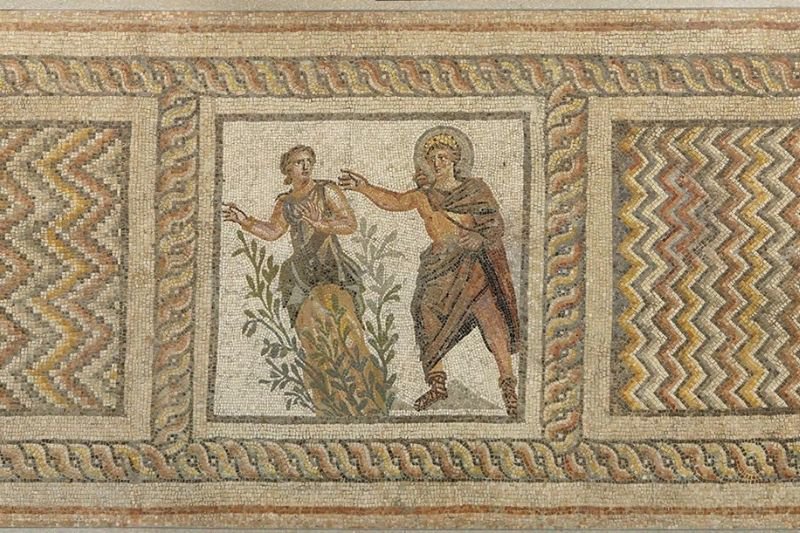
Apollo and Daphne
Mythological tales have long served as reflections of humanity’s attempts to make sense of nature, the cosmos, and existence itself. These narratives are not merely entertaining stories but are woven with symbols that carry profound wisdom. The tragic love story of Apollo and Daphne may seem at first glance like a romantic tale of pursuit and escape, but in truth, it is a metaphorical narrative that speaks to the cycles of nature and the human mind’s struggle against darkness.
Apollo is the god of light, the sun, and wisdom. Daphne is not just a nymph—she is also a symbol of dawn’s crimson glow, of twilight itself. Apollo’s passionate chase after her mirrors the sun’s attempt to seize the fleeting horizon at daybreak. Yet no matter how fervently he pursues her, he can never truly reach Daphne, just as the sun can never fully dispel twilight. This eternal chase represents the rising and setting of the sun, an endless cycle. Daphne’s final transformation into a tree symbolizes the permanence of nature and a reality beyond human desires.
Yet this myth is not merely an allegory for natural phenomena. It also reflects the tension between masculine and feminine principles. In the patriarchal discourse of the ancient world, reason and wisdom were often associated with the masculine, while the unknown, darkness, and the mysteries of nature were attributed to the feminine. Apollo’s pursuit of Daphne embodies the intellect’s struggle to comprehend the unknown, light’s attempt to conquer darkness. But Daphne’s constant evasion serves as a reminder of the elusive, uncontrollable nature of the feminine.
This myth shows us that mythological narratives are not just entertaining fables. When read correctly, they carry deep traces of the universe’s workings, humanity’s inner conflicts, and societal codes. The story of Apollo and Daphne is not only a nature myth explaining the sunrise each morning but also a philosophical text questioning the limits of knowledge and humanity’s stance in the face of the unknown.
Therefore, viewing mythology merely as superficial storytelling means overlooking its richness. To grasp its true meaning, one must listen to the voice behind the symbols. For myths are the most ancient reflections of humanity’s collective consciousness.
Last Modification : 8/31/2026 11:57:30 AM