Naime Sultan Mansion
Rising on the captivating shores of the Bosphorus in Ortaköy, Naime Sultan Yalısı (Mansion) is not merely a masterpiece of architecture but also a monument that bears witness to the final era of the Ottoman Empire, the poignant life of a sultan, and the modernization efforts of Republican Turkey. Despite changing functions over time and a devastating fire, the structure has managed to preserve its grandeur and survive to the present day.
Architectural Grandeur
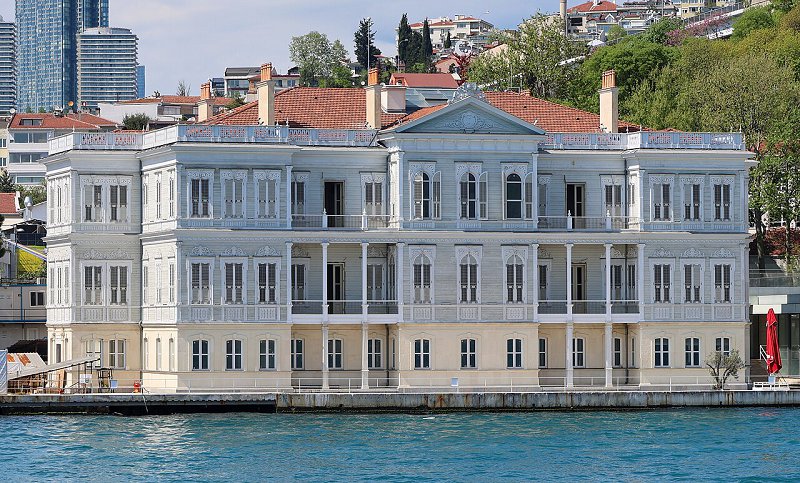
Commissioned by Sultan Abdülhamid II in 1876, the mansion is one of the finest examples of the Neobaroque style, a popular trend of its era, along the Bosphorus. The two-story wooden structure, with its symmetrical plan, is considered one of the most successful applications of mansion architecture of its time. The central section is elevated, and its triangular pediment draws attention.
The architectural layout of the mansion is quite unique. Designed with a two-sided sofa (hall) scheme, the halls located in the north and south are considerably distant from one another. Each floor contains ten rooms, a sofa, two corridors, two restrooms, two staircases (one in the north and one in the south), and two balconies on the seaside façade. The balconies on the service floor and the first floor are supported by columns.
One of the most striking features of the structure is the circular ornamentation on the ceiling of the entrance hall. This decoration, described in a single word as "magnificent," showcases one of the most refined craftsmanship examples in civil architecture of its era. The oil paintings on the gilded cove ceilings add a distinct elegance to the building. The areas above the windows on the middle floor are more richly decorated than other windows, revealing the hierarchical spatial concept of the building.
Naime Sultan Yalısı was constructed to be larger and more splendid than its northern neighbor, Hatice Sultan Yalısı. Diverging from classical Ottoman architectural features, this structure is arranged perpendicular to the sea, with all its rooms and salons positioned to offer a view of the water. Renowned for its unique landscape decorations, the mansion also had a small pavilion (kasır) at its rear, which was demolished in later years due to road construction.
The Course of History: A Sultan's Story
Long believed to belong to Fehime Sultan, the mansion was, in fact, owned by Naime Sultan, the daughter of Abdülhamid II. The building's history gained a new dimension in 1883 when it was gifted to Gazi Osman Pasha. In 1898, when Naime Sultan, daughter of Abdülhamid II, married Kemaleddin Bey, the son of Gazi Osman Pasha, she came to this mansion—then known as "Osman Pasha Mansion"—as a bride. Following renovations by the sultan, the mansion began to be called "Naime Sultan Yalısı."
Born to Abdülhamid II's consort Bidar Kadınefendi, Naime Sultan was born on the very day her father ascended the throne. Due to this auspicious coincidence, Sultan Abdülhamid celebrated two joyous occasions on the same day: his accession and his daughter's birth. Naime Sultan, who received Western music lessons and played the piano exceptionally well, settled in this Ortaköy mansion after her marriage. However, due to marital problems, she divorced her husband and was later married to İşkodralı Celaleddin Pasha. As the person who initiated the tradition of wearing a white wedding dress in Turkish history, Naime Sultan holds a unique place in our cultural history.
Exile and Sorrow
With the exile of the Ottoman dynasty abroad, Naime Sultan was forced to leave, first for France, and then, with her husband and two children, to her husband's homeland, Albania. Shortly after, Celaleddin Pasha fell ill and passed away. Left alone in a foreign land with her two children, Naime Sultan was confined to her bed by poverty, misery, exile, longing for her homeland, and loneliness. She passed away helpless and alone during the years of World War II. A life that began in palaces thus ended in exile, fading into history with all its experiences and memories.
The Republican Era and the Present Day
As the dynasty was sent into exile, Naime Sultan bequeathed her mansion to the state for educational purposes. This decision paved the way for the structure to serve as an educational institution for approximately 70 years. After remaining vacant for a while, the mansion was used as Darüleytam (an orphanage) and a tobacco warehouse from 1926 to 1933. In 1933, it was converted into Gazi Osman Paşa Secondary School, serving education in Ortaköy for about seven decades.
A fire in July 2002 rendered the structure unusable. In 2003, the mansion was leased to be used as a parking lot, and its schoolyard served this purpose for a period. Naime Sultan Yalısı and the adjacent Hatice Sultan Yalısı, both designated as first-degree historical monuments, were eventually leased for 25 years to be operated as a hotel, under the condition that they be restored authentically to their original state.
Naime Sultan Yalısı is far more than just a building; it is a cultural asset that has witnessed the final years of an empire that once spanned three continents, the tale of a sultan's daughter marked by both joy and sorrow, the educational mobilization of the Republic, and the challenges of urban transformation. Restoring this unique, fire-damaged structure to its original glory would signify not merely the revival of a building but also the revitalization of Bosphorus culture and memory. As it has throughout history, Naime Sultan Yalısı continues to bridge the past and the future within Istanbul's ever-changing landscape.
Last Modification : 10/17/2026 5:06:42 AM