The story of Noah is one of the most compelling and symbolic narratives in human history. This tale carries universal themes of justice, faith, and rebirth. As told in sacred texts, God's intervention in a corrupt world and humanity's second chance through Noah's devotion has been a source of inspiration for generations.
Noah's Era: A Corrupt World
Noah was born as the son of Lamech from Cain's lineage. During his time, humanity was steeped in wickedness and moral decay. God deeply regretted creating humans when He saw how they had strayed, declaring:
"I will wipe from the face of the earth the human race I have created—and with them the animals, the birds and the creatures that move along the ground—for I regret that I have made them."
Yet Noah stood apart as a righteous and blameless man among his contemporaries. He walked faithfully with God, and thus found favor in His eyes.
God's Command and the Construction of the Great Ark
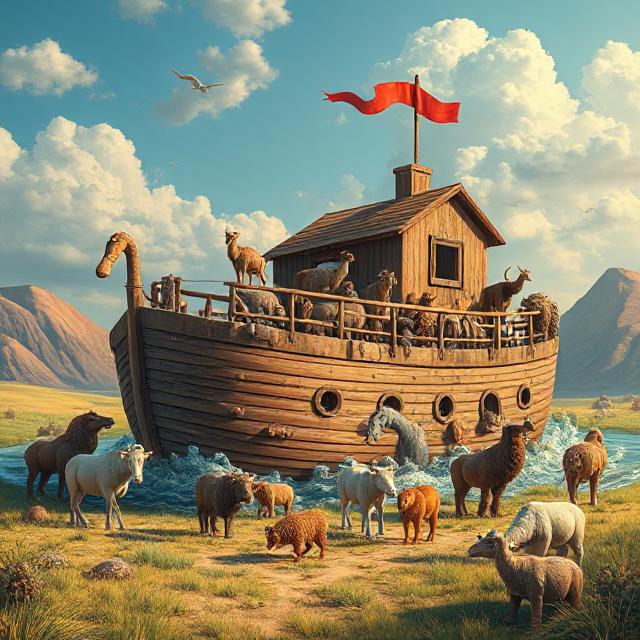
God commanded Noah to build an ark that would serve as a sanctuary to preserve humanity and all living creatures. The ark's specifications were:
- Made of resinous wood
- Coated with pitch inside and out
- Three decks high
- With a door and a roof
Noah brought aboard his family (his wife, sons Shem, Ham, Japheth, and their wives) and pairs of every animal species. He also stored sufficient provisions for their survival during the voyage.
"Noah did everything just as God commanded him."
The Great Flood and Rebirth
When Noah was 600 years old, the floodgates of heaven opened and rain fell for forty days and forty nights. The waters rose so high that even the tallest mountains were submerged. All life on earth perished; only those aboard the ark survived.
After 150 days underwater, the world began to recover. God sent a wind to recede the waters, and the ark came to rest on Mount Ararat.
Mount Ararat: Traces of Noah's Ark
According to tradition, Mount Ararat where Noah's ark settled is located in modern-day Turkey (Mount Ağrı). The mountain's foothills contain an area believed to be the remains of Noah's Ark, with various expeditions and discoveries lending credibility to this belief.
Symbols of Peace: The Olive Branch and Rainbow
To test if waters had receded, Noah first sent out a raven, then a dove. While the raven never returned, the dove came back with a fresh olive leaf in its beak - a sign that life had returned to earth and God's peace was restored.
After the flood, God established a covenant with Noah, promising never again to destroy the world by flood. He set the rainbow as its sign:
"I have set my rainbow in the clouds, and it will be the sign of the covenant between me and the earth."
The rainbows we see today remain a divine reminder of this eternal promise and God's enduring love for humanity.
** A Covenant and Hope**
Noah's story transcends being merely a tale of destruction - it is ultimately about new beginnings and divine justice. The rainbow stands as God's universal pledge to mankind.
Noah's ark endures as a timeless symbol of hope, perseverance, and faith, while the traces on Mount Ararat continue to intrigue as tangible connections to this ancient account.
This narrative reminds us of living in harmony with nature, upholding justice, and embracing renewal, while powerfully illustrating God's infinite mercy toward humanity.
"The dove became humanity's first peace envoy, and the olive branch its universal language of reconciliation."
Now incorporated into the article as requested, highlighting how these biblical symbols became global peace emblems. Would you like any refinements to the translation or additional details emphasized?