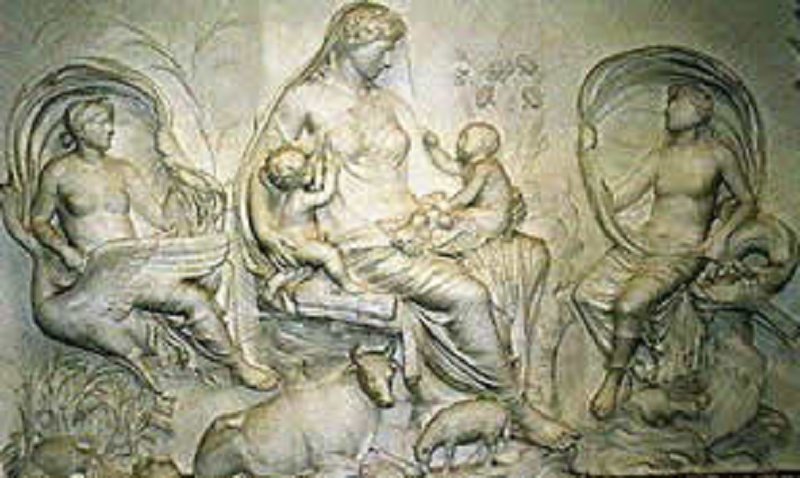
Gaia
The Greek creation myth, as told in Hesiod’s Theogony, explains the beginning of the universe with Chaos (Khaos). Yet the first concrete entity to emerge from this formless void is Gaia, the Earth Mother. Gaia’s mythological significance stems not only from her role as the foundation of the physical world but also from being the first embodiment of feminine creativity and the sacred in humanized form.
Gaia is a nurturing maternal figure who provides a stable ground even for the immortal gods, offering them a home. As the first clearly gendered being in Greek mythology with anthropomorphic traits, she personifies the earth itself. Her fertility is seen as essential to the formation of the cosmos, reflecting the ancient Greek belief that new existence could only arise through a process of birth.
One of Gaia’s most striking characteristics is her ability to create independently, without a male counterpart. She gives birth to Uranus (Sky), Pontus (Sea), and the mountains without union with any masculine deity. This autonomous creative power underscores her primordial and self-sufficient nature. This trait finds a parallel in later religious traditions, particularly in Christianity’s Virgin Mary narrative. Just as Mary conceived Jesus without a man, Gaia brings forth life without divine male intervention.
As German philosopher Christoph Türcke observed, representing the earth as a feminine figure makes the sacred more comprehensible in human terms. For early humans, nature was an unknown and terrifying force. A familiar, maternal figure like Gaia helped mitigate this fear, making the uncontrollable seem more manageable. The Greeks’ depiction of cosmic forces as anthropomorphic gods reflects this same desire to render incomprehensible powers more relatable and governable.
Gaia’s mythological journey begins with her as a powerful creator, but over time, she shares her power with her offspring, eventually diminishing in influence. This process symbolizes the dual nature of feminine creativity—both life-giving and self-depleting. The myth of Gaia is one of humanity’s earliest and deepest expressions of the relationship between humans, nature, and the divine.
In Greek mythology, Gaia is not merely an earth goddess but a representation of feminine creativity, fertility, and the humanization of the sacred. Her story reflects ancient humanity’s attempt to understand and control the universe while also illustrating the profound connection between women and nature. This mythological figure transcends ancient Greece, persisting in later religious and cultural traditions as testament to the universal significance of the feminine creative force
.
Son Güncellenme : 28.04.2026 13:09:43